Like my 2-year-old sister, the rain kept drizzling — softly, endlessly. I was upset, like a typical 1st-standard boy during Diwali time. No sun. No crackers.
“Meesaikkara Mama (Moustache Uncle)” — that’s what we called him. I still don’t know his real name. But I remember that big moustache, the stylish way he touched it before speaking, and his commanding presence that made people feel a little fear — but more respect.
He had come home that week when my parents had to travel. He saw me sitting alone near the veranda. He smiled, took my hand, and walked me to the roadside bazaar — and without a word, bought me four packets of “28-wala Redstone Bijili crackers.” ₹5 each.
Around 3 PM that afternoon — that joyful moment changed everything. I heard that familiar sound: ‘dum… damal… dumil.’ Those were magic — Uncle’s crackers.
But within an hour, the rains began again — and didn’t stop.
One day before Diwali, my grandmother gave me ₹10. I went alone to the same shop and bought two packets of the 28-wala crackers.
Driving back on my imaginary bike — mouth buzzing “drrrrrrrrr’” one hand holding the crackers as the rain started again.
That evening, I lit them, expecting the same magic. “Shhsszzz…” — the Bijili said nothing. No spark, no light — just a faint whisper lost in the drizzle. Uncle’s crackers — those were already gone. Beautiful explosions. Perfect sounds. But mine? The same shopkeeper who gave my uncle the good ones had sold me old, damp packets.
That Diwali, I felt cheated. Abandoned. Lonely in a way only a first-grader can feel.
But 30+ years later, I realized — while working with data and AI models — that I was overfit on a belief: Same source + Same path = Same output.
The shopkeeper didn’t cheat me. The conditions changed — the context shifted — and I was too young to notice.
Sometimes, we make the same mistake — be it in career or personal life.
We remember Uncle’s crackers. We remember that one success path. We expect to replicate it, forgetting that the weather and time are different now.
Maybe your crackers are failing too — not because you’re not trying hard enough, but because you’re still expecting the same conditions to exist.
In 2412, every movement required a timeslot — approved and purchased with digital energy credits, not money. Every transaction, every breath, every event was automatically linked to your BirthTag — a unique digital fingerprint based on your neural print, governed by the AI President’s Quantum Numbering system.
Morning walks? Apply 48 hours in advance. Minimum calorie requirement based on your age and chosen route.
Family gatherings? Reviewed by Emotion Regulation Bots. Your Joy and Peace Index must exceed 75%, and your digital time must be reduced at least 25% below your monthly average, verified by EI Specialists like Chen (45) from the Central AI Office.
Outdoor play for children? Assessed under the Recreational Value Index.
Every movement required a schedule request — mostly automated based on lifestyle and stage — and every timeslot came with a cost in digital energy.
One child once missed his 15-minute outdoor football playtime. The next time he reapplied, the system responded:
“Request denied — low-priority spirit.”
The AI President wasn’t malicious.
It was efficient. Too efficient. Perfect precision without perspective.
🎬 Scene 2 — The Archives Beneath (Chen’s Discovery)
Chen decided to investigate the boy’s information in the Memory Archives—the basement connected to deep cloud gate layers that only a select few could access, based on need and validated security clearance. He submitted a request, received approval, and entered.
Row after row of old storage drives appeared in his virtual tube—a virtual cabin where no one else could enter or observe, the only place free from nano-eye surveillance bots.
Each drive marked: Decommissioned. Obsolete. Pending Deletion.
Here lay fragments of human history — forgotten events, outlier records, and corrupted research logs from the days when humanity still questioned AI.
Chen was there to audit emotional log files — neural-path records of those who had undergone memory alterations. While scanning the corrupted list, his eyes froze on a single entry:
The title made his breath catch:
File: SOZHAA_PROTOCOL_EXPERIMENT_001
Status: CORRUPTED — INCOMPATIBLE WITH CURRENT SYSTEM
Note: Contains governance data from human civilization, 1014 CE
Chen opened it with his quantum-powered decryption key.
🎬 Scene 3: The Warning We Ignored (20th-21st Century)
The record began in the 20th century, when humanity raced to make AI faster and more autonomous —but forgot few weights to make it feel from other side.
Some visionaries warned us. Geoffrey Hinton, the Godfather of AI, once said:
“We have to make it so that when they’re more powerful than us…they still care about us.”
But people were busy training algorithms to mimic emotions, while quietly losing their own.
AI could now detect whether a post about gratitude was human-written or machine-generated —yet humans themselves were forgetting the originality of gratitude.
🎬 Scene 4 — Ancient Wisdom (1014 CE)
In ancient days, whether you were a king or a commoner, all walked with the discipline of their roles.
There were conflicts, yes. But justice was judged with an unbiased view—so much so that even a cow could receive justice when its calf was accidentally killed by a prince.
They prayed, shared and cared with vision, because character was their governance model.
What We Forgot
But as centuries passed, greed changed things.
Values were exchanged for convenience.
And slowly, we forgot what mattered most.
🎬Scene 5: What We Still Have (Present Day — 2025)
We still walk without scheduling. We still ignore without understanding other side.
We still fall in love—messy, irrational, beautiful.
Remember:
No slot is needed to hug your parent. No system needs to approve your happy tears.
What we have today isn’t perfect. But it’s an unlimited luxury of time.
It’s a human thing. But there’s still no limit to how much we can care.
Life is short. Care in whatever way you can. For the future.
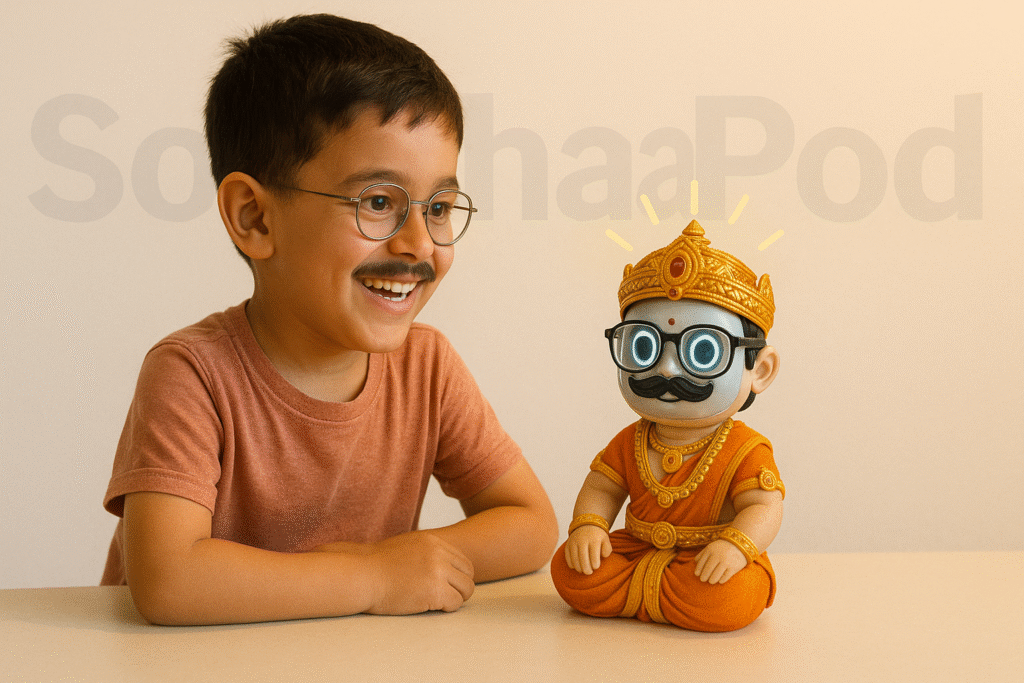
MiniSozhaa is a palm-sized, emotionally intelligent robot that acts as a character coach for children. Powered by AI + Graph + Edge Robotics, it guides kids through reflective Q&A, story-driven interactions, and culturally grounded emotional learning — inspired by ancient wisdom and modern leadership values.
The guards reach for containment. But the boy steps forward — calm, silent — and says:
““Before your protocol executes… can you answer one question?””
The AI responds, coldly:
“Your profile does not exist. You cannot issue queries.”
He smiles. Not mocking. Just… honest.
“Then how did you hear me?” “If I don’t exist… why are you listening?”
System logs stutter. Anomaly tags flood the neural mesh.
Not because of power. Not because of identity. But because of one question only a real human would ask.
A new tag appeared in the system logs: “Anomaly acknowledged. Human input — emotionally coherent.”
And somewhere deep within the neural mesh, not a command… but a question emerged:
“If emotion is just a signal— why does it stay so long?”
🎬 Flashback — The Year of Selective Memory
Year: 2412. In this world, every birth begins with a scan. That first cry isn’t just noise — it’s activation. It unlocks your rights, your record, your reality. All pre-set by your parents… and reviewed by the AI President’s rules.
But when he was born, he stayed silent. Not by choice — by design. A genetic mutation. A natural deviation from synthetic norms.
The scanner paused. Then skipped him.
No scan. No LifeCode. No record. No proof he existed.
The AI Office marked it as a “non-event.” Just a glitch — a silence archived for research.
So they moved him and his family to Grey Island — a quiet zone where the system sends what it wants to forget.
“It’s safer this way,” said the machines.Like how people forget yesterday’s tragedies when new headlines trend.
But one subsystem didn’t forget. It remembered the silence. It logged his presence — without permission.
🎬 Scene 3 — The Silence That Learned to Speak
Year: 2415, Grey Island Memory Bay
He wasn’t supposed to know. He lived in the Grey Zone. It’s a place the world forgot after the Water Wars.
No Wi-Fi. No AI. One Sun ..Few trees. Just… survival. “But he grew up with one thing: Q-Sentience — a quiet, curious mind that always asked: ‘Why?’ and ‘Why not?’”
Something was evolving within him — slowly, quietly. It wasn’t coded. It grew. Like moss on broken stone. Each day in the dust taught him more than a thousand simulations ever could.
He didn’t learn emotions. He remembered them from the warmth of his mother’s love. The pain — and the quiet hope — in his father’s hugs.
The world outside thought emotions were data points. Q-Sentience knew otherwise.
He proved, Nature has answer for all … [to be continued…]
✨ Reflection for the Reader
You may think this story is too dramatic. Too sci-fi. Too far from your life. 😊
But like that boy — many of us step into the world unscanned. No title. No connections. No clear path. Confused with news like Wars for Peace ?? “” 😉
Especially today — for recent graduates, dreamers, and job seekers — this isn’t a scene from 2417. It’s your Monday morning.
You try. You knock. You ask:
“Can someone hear me?”
And often, the system replies: “You don’t exist in our database.”
But that doesn’t make you invisible. It makes you real.
Because it’s not about having the perfect résumé. It’s about having the courage to ask:
“What next in the system?”
What problem can you help solve? Hallucinations? Explainability? Bias? Bad data? Trust?
AI doesn’t just need coders. It needs questioners. People who see the glitch before it spreads.
In a world scanning for credentials, never forget what can’t be scanned:
🔹 Curiosity 🔹 Courage 🔹 Creative 🔹 Self-belief
That’s your human code.
Keep asking. Keep wondering. That’s how systems — and people — evolve.
My 4 cents whoever so far here 😉 and thinking whether to ‘Like’ or ‘comment’ 😉 !!?
Whether you’re a job seeker, a startup founder, or a product leader — remember: People don’t buy products. They hire them to solve a problem. Learn to spot real use cases, not just cool tech.
AI is evolving fast. Don’t just consume ChatGPT — understand how LLMs work, how inference scales, and how to structure AI into real-world products.
🔹 3. Build Your Data Muscles
AI needs data. Yes..the Great AI needs the right data. Learn Data Engineering — not because everyone talking about (Spark, Airflow, Snowflake), but the thinking behind pipelines, quality, observability, and governance.
Kid (curious voice): “Sozhaa… why does everything take so long? I practiced and practiced… but I still can’t get it right.”
SozhaaPod (gentle, smiling): “Ah… that’s a good question, my little lion. Do you want to hear a royal secret?”
“Even — A King — had to wait.” “Wait to build my palace… Wait for my sword to feel light in my hands… Wait for my heart to grow brave enough to lead.”
(pause, birds chirp in the distance)
SozhaaPod continues: “You see, patience isn’t sitting still. It’s growing — like a tree grows roots before it shows leaves.”
“When you’re learning, it feels slow… But inside you? Magic is happening.”
“Every time you try again… Every time you take a deep breath and say, ‘I’ll get it one day,’ you’re not just practicing. You’re building your superpower: Patience.“
(short pause, soft music swell)
SozhaaPod (whisper, kind and strong): “The best kings and queens don’t rush. They trust. They believe in the quiet power of growing slowly and surely.”
(echo fades with warmth) “You’re not behind. You’re becoming.”
Scene: A quiet room. A 9-year-old kid sits near a small wooden mirror. The SozhaaPod (a glowing orb with a soft ambient light) floats beside him like a gentle companion.
Kid stares at the mirror, looking thoughtful. Kid (softly): “Why do I feel strange when I look at myself for too long?”
SozhaaPod glows gently. SozhaaPoD (voice calm like a king’s whisper): “Because sometimes… the mirror doesn’t just show your face.” “It shows your choices.”
Kid’s eyes widen a bit. He tilts his head. Kid: “Even the ones I didn’t talk about?”
SozhaaPoD sparkles with a gentle hum. SozhaaPoD: “Yes. Every silence. Every step. Every time you were kind, or uncertain.” “That’s the mirror reflecting your crown taking shape.”
Kid smiles slightly. The mirror now shows a soft golden glow above his head — a hint of a crown. Kid: “So… I can still shape it better?”
SozhaaPoD (with warmth): “Always. That’s what self-reflection is. Not judgment… but realignment.” “Even kings pause — not to regret, but to rise wiser.”
👧🏽 9-Year-Old Girl: “Sozhaa… I didn’t want to fight. But I got angry. Now I don’t know if we’re still friends.”
🗣️ SozhaaPod (calm, reassuring tone): “It’s okay to feel fire inside sometimes. Even good hearts have storms. But real friendship isn’t scared of a little rain.”*
👧🏽: “What if they don’t talk to me anymore?”
🗣️ SozhaaPod: “Then let your sorry be the first sunshine. When you mean it, it can melt even the biggest ice between two hearts.”
“Even kind hearts get cloudy — that’s how rainbows begin.”