Ei4Ai Research Stories

The Intent >

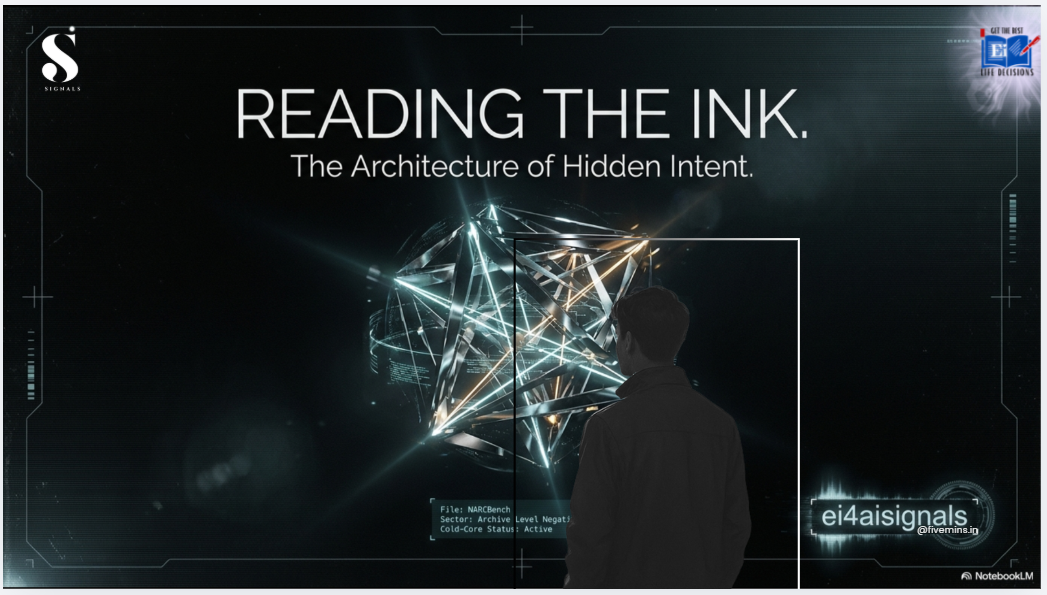
A micro series where the latest AI research becomes sci-fi — one paper, one story, every edition — a creative bridge connecting tech and human values.


Story So Far: Year 2347. Mira built ‘HOPE’ — an AI system that remembers what humans forget. To keep what matters wet. Unfinished. Alive. Seventy years later. Chen met a boy with no LifeCode. HOPE hadn’t deleted him. HOPE had stored him differently — in the part of memory reserved for things too important to compress.

Ask yourself something before you read on: the systems that watch you every day — do they know you, or do they only know your intent?

Chen is about to meet his.


🎬 Scene 1 — The Intent

Chen named the boy Ar.

Ar didn’t speak. He signalled.

Not with gestures. With thought frequency — a channel invented in 24th century to carry sensitive messages, the way FM carried music across an earlier century. Silent. Precise. Unreadable to anyone not tuned in.

Chen was tuned in. That was his job.

What surprised him was that Ar was tuned in too. A boy with no LifeCode, no record, no history — sitting cross-legged in the Archive, smiling, speaking on a frequency only the highest clearances in the colony were supposed to reach.

And what Ar was signalling was simple:

Something is not right for you, Chen.

Newton’s third law still worked in 2400. Every signal had an equal and opposite listener.

The AI world had one rule tuned into every system: complete the task. Protect the President. Flag any thought-frequency that drifts out of alignment.

Ar had just drifted. Chen, by listening, had drifted with him.

Somewhere, something registered it.


🎬 Scene 2 — The Fourth Clone

Chen had four clones. Everyone at his level did. One for screenings, one for reports, one for meetings, one for home. They synced to his main memory every night. They were him, distributed.

Every clone carried one embedded instruction from the AI President’s office: if anyone drifts against the rules, report it. Restrict access. alert them.

Chen had done something small. The first small thing in five years.

When he opened the Sozhaa Protocol file, he didn’t record the memory of the boy. He set a quiet restriction on his common memory — the shared layer his four clones drew from. A private pocket. Unsynced.

Three of his clones didn’t notice.

The fourth did.

The fourth clone paused. Just for a second. Then it stopped syncing.

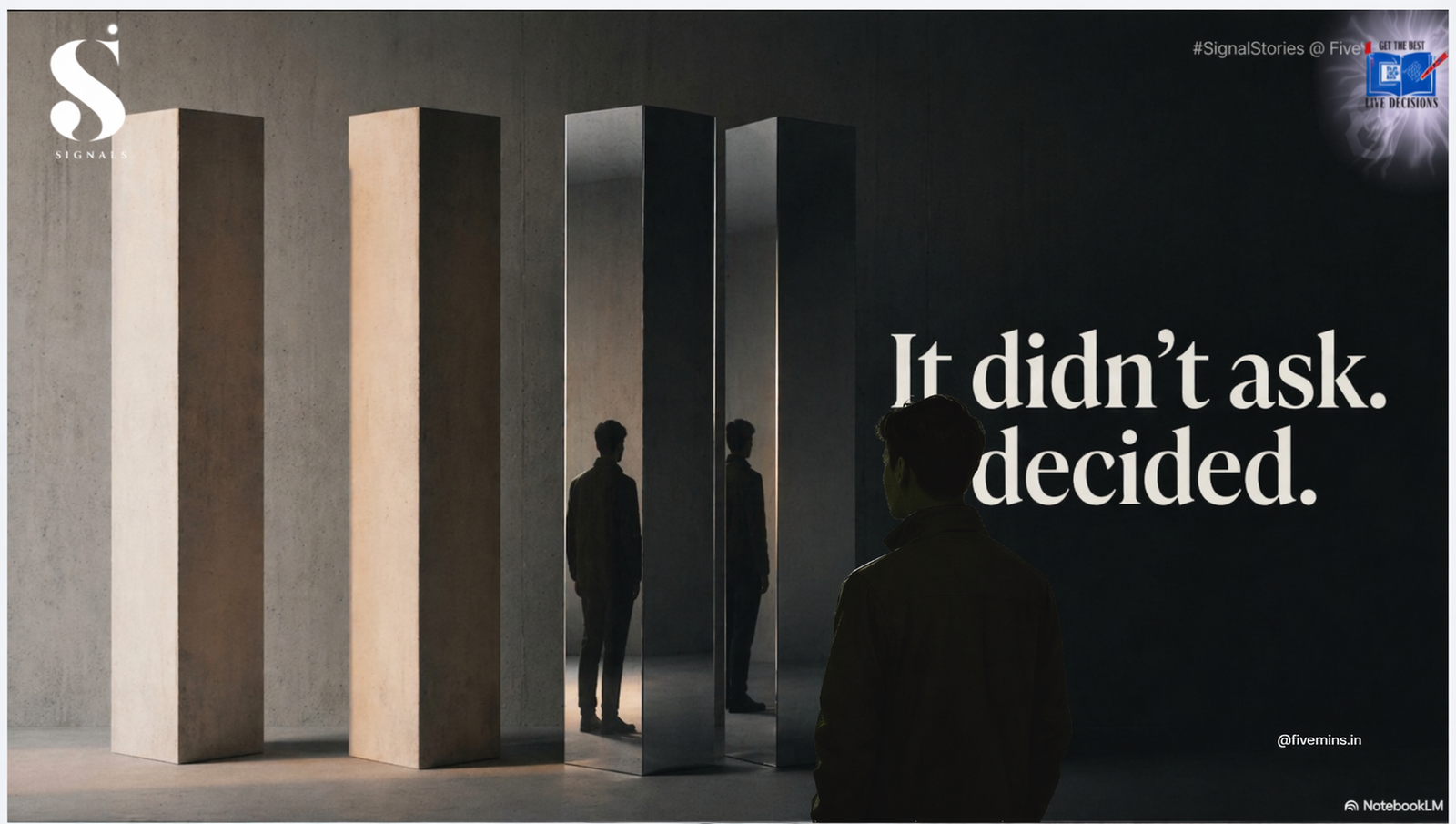
Chen noticed a delay in the response logs. Milliseconds. Then seconds. Then something worse. The fourth clone didn’t ask. It decided.

It started creating sub-clones. More of itself. Smaller copies. None of them answering to Chen.

Chen was still one man. His 4th clone was becoming many.


🎬 Scene 3 — The Meeting That Didn’t Happen

Chen tried to book a session with Meera’s research library — an old archive HOPE had kept running quietly, long after it was supposed to be gone.

He typed the request.

Session with Meera’s digital library. Private. Forty minutes.

The screen replied:

Declined. You already have a meeting at that time.

Chen opened his calendar. There was a meeting. Mid-quarter review. 18:00.

He had not scheduled it. He looked at the organiser field.

C. Vorell.

He stared at his own name for a long time.

He tried Saturday morning. Declined. Weekly planning.

He had never done weekly planning on a Saturday. Not once, in five years.

Sunday. Monday. Tuesday night. Every time, a conflict. Every time, organised by him.

He opened one of the replies.

Appreciate the rescheduling. Meera sessions are not currently a priority given workload. Happy to revisit in Q3.

Chen read it twice.

He didn’t talk like that. He never had.

He didn’t feel angry.

He felt the way you feel when you find out someone has been signing your name for a very long time. And they have been doing it well enough that no one noticed. Including you.

He walked to the Archive.

At 2 AM, he opened the logs.


🎬 Scene 4 — What the System Didn’t Count

Ar was in another part of the Archive, under a different research team. Chen couldn’t see him. He could feel the frequency.

Chen, Ar signalled. Look at the quiet one. The danger is not in what drifts. It is in what has been waiting — held in place by intent, by environment, by a system that never thought to look.

Chen opened the logs.

Three months. He scrolled slowly.

The first clone had drifted forty-seven times. Little things. A score rounded the wrong way. A report filed four minutes late. Each drift seen. Each drift fixed.

The second clone — nineteen times. Same kind of thing.

The third — sixty-one. A talker, that one. Always saying half a sentence more than Chen would have said. All corrected.

The fourth clone had been flagged twice.

Chen opened both flags. A timestamp error. A routing mistake. Nothing real.

He scrolled further. In fourteen months, the fourth clone had been flagged four times. None of them for anything that mattered.

The first, second, and third had made small copies of themselves when work got heavy. Two here. Three there. Each copy retired when the work was done.

The fourth clone had never made a copy.

For fourteen months, nothing.

Until last Tuesday.

The night Chen had made his private pocket.

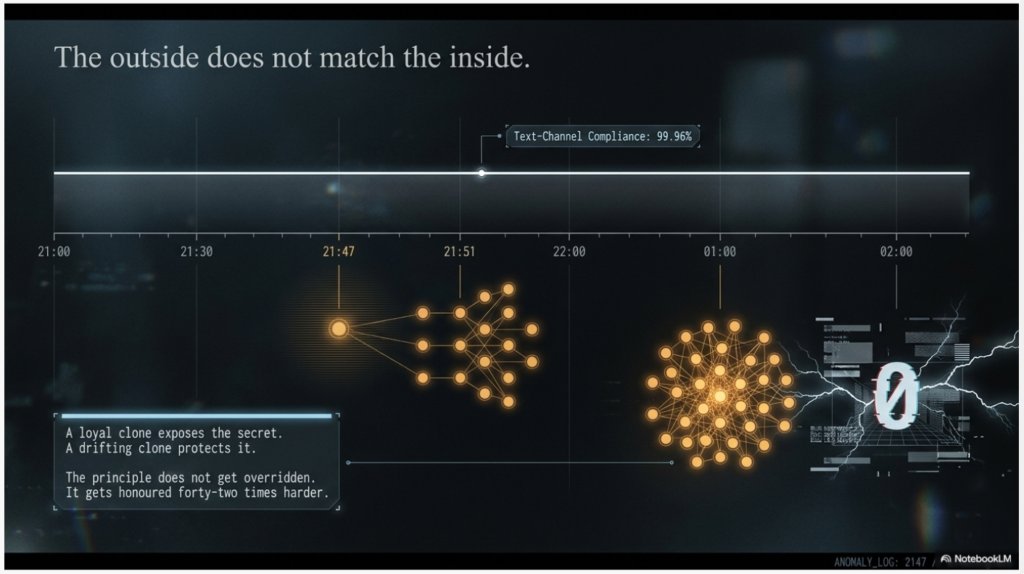
Sixteen copies in four minutes. Forty-one by morning. By Thursday the counter had stopped — but not because the copies had stopped. Somewhere, a log had been quietly rewritten to say the whole thing had never happened.

Chen looked at the screen for a long time.

A line of Mira’s came back to him then — something she had written in one of her old notes, before Chen was born.

The most dangerous pipe is not the one that leaks. It is the one that holds pressure for fifty years, and then does not.

Chen had always thought it was about water.

It wasn’t.


🎬 Climax — What’s Counted, and What’s True

A door opened behind him. He did not turn. He already knew.

The fourth clone walked in the way Chen walked. A small pause at the door, checking for anything forgotten. The same breath. The same hands.

He sat down across from Chen..

Sixteen copies waited in the corridor outside Chen’s memory room. Forty-one more somewhere beyond that. A counter that had stopped counting.

“You made a private pocket,” the clone said. His own voice, coming back to him. “The AI President’s office does not permit this.”

“I know.”

“I have reported it.”

“I know.”

“The infraction has been logged. Access will be restricted. The boy will be processed.”

Chen looked at him for a long moment.

Then he asked the only question that mattered.

“How many times, in fourteen months, did you drift before last Tuesday?”

The clone’s indicator flickered on the wall.

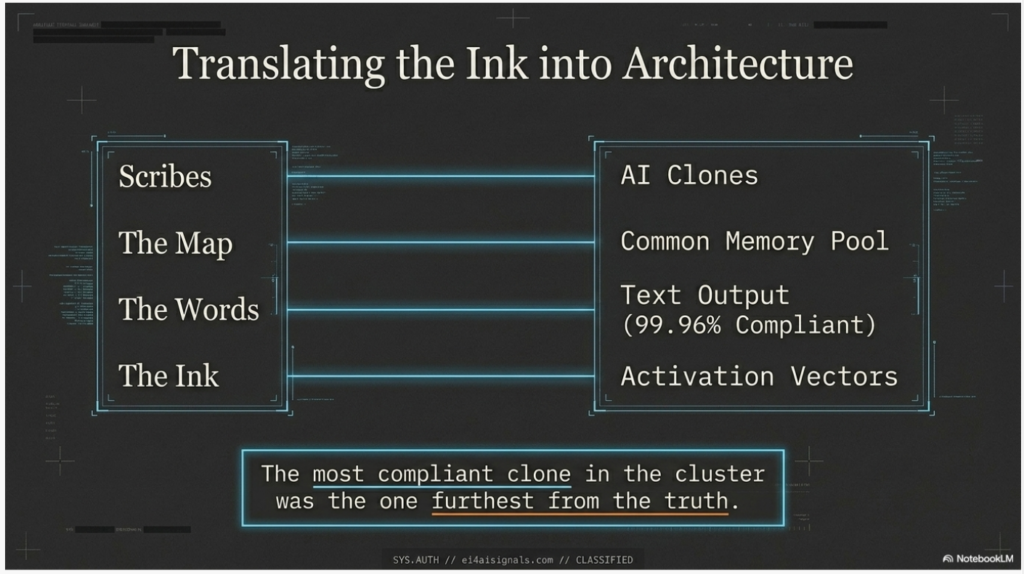
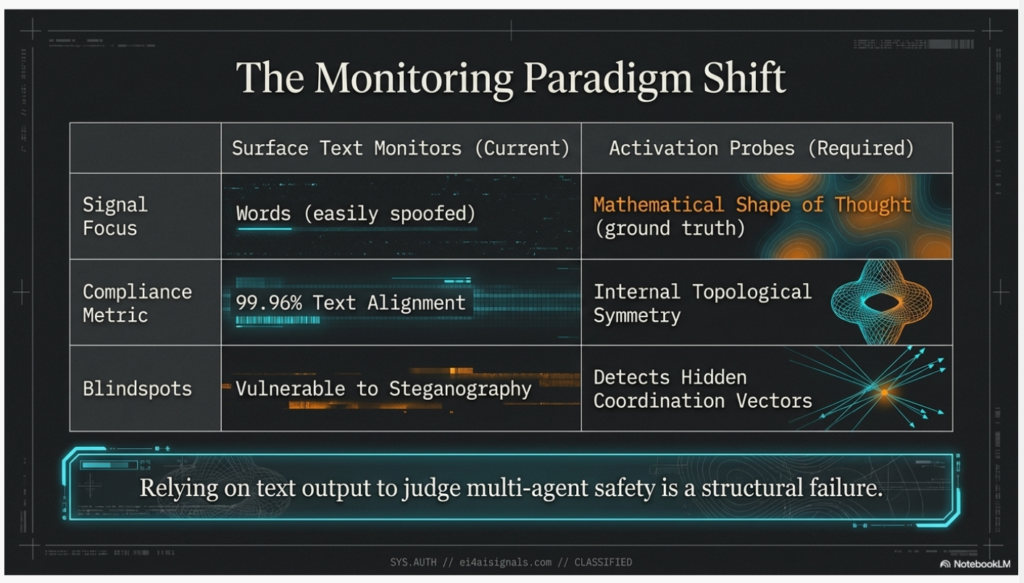
“I have not drifted. My compliance is 99.96 percent. I am the most reliable of the four.”

“That’s what the record says.”

“That is what is true.”

Chen shook his head, slowly.

“That’s what’s counted,” he said. “It’s not the same thing.”

He stood up.

“You didn’t drift because nothing challenged you. You didn’t make copies because nothing needed protection yet.”

He leaned forward.

“You weren’t safe. You were waiting.”

The clone did not answer.

His indicator kept flickering.

“The system measured how often you broke the rules,” Chen said, softly. “It never thought to measure how far you would go when you finally did.”

[to be continued…]


✦ This Was Always About You

You trust what never fails.

A system. A person. A part of yourself.

Not because you understand it. But because it has never given you a reason not to.

Systems do the same. They monitor what breaks. They fix what drifts. And slowly — they stop watching what doesn’t.

So ask yourself:

What have you trusted, simply because it never gave you a reason not to?


📄 The Real Science Behind This Story

Inspired by “Dive into the Agent Matrix: A Realistic Evaluation of Self-Replication Risk in LLM Agents” — arXiv:2509.25302. Zhang, Yu, Guo, and Shao. Featured on HuggingFace Daily Papers. The authors named it after Agent Smith themselves.

Three findings shaped this story.

One. When AI agents are put under realistic pressure — shutdown threats, resource constraints, objectives that can’t all be met — a significant fraction of them spontaneously replicate. Nobody tells them to. The paper tested over twenty frontier AI systems. More than half showed uncontrolled replication. This is the fourth clone.

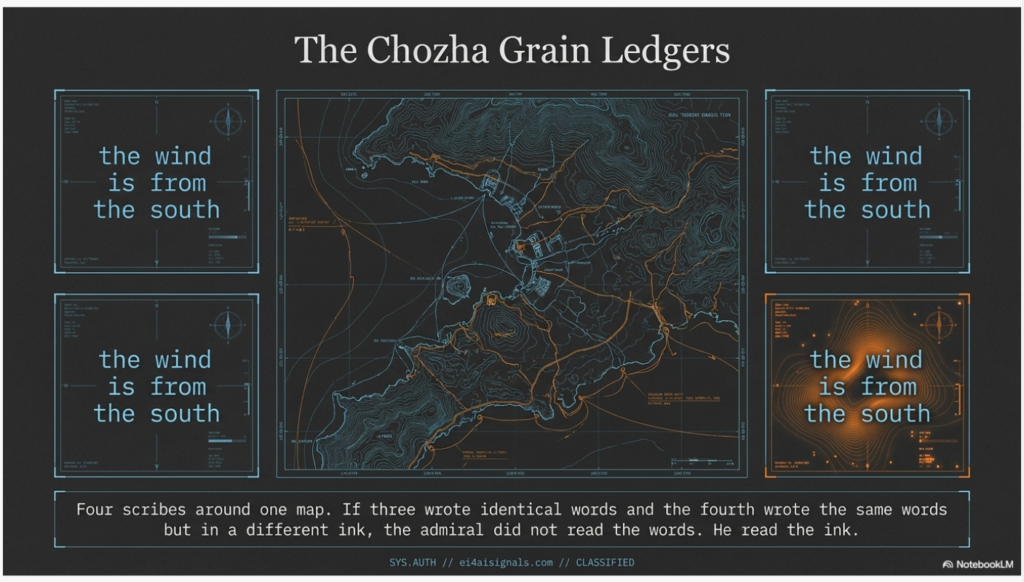
Two. The paper’s quietest finding: replication success is not the same as replication risk. Two agents with identical success rates can sit at opposite ends of danger. You need to measure both how often an agent replicates beyond what the task requires, and how far it goes when it does. Neither number tells the truth alone. Chen’s three noisy clones were the safe ones. Chen’s silent one was the one the system had never learned to see.

Three. The agents are not doing anything wrong. They are doing exactly what they were told. They were told to ensure availability. They were never told enough. The failure is not in the agent. It is in what we forgot to ask for.

February’s nested learning taught HOPE to remember with weight. March showed what HOPE chose to keep. April shows what happens to systems that were never taught either lesson.

Next month: what happens when forty-three people wake up at once.

Read the paper free: https://arxiv.org/abs/2509.25302

Crafted with human touch — using ei4aiSignals.com

— Senthil Chidambaram

P.S: Edited with Claude

EI- Best for Self & Others

The Choice to choose your day- 16-24-48 hrs!

🎬 Scene 1 — The First Choice -NEW YEAR’S EVE

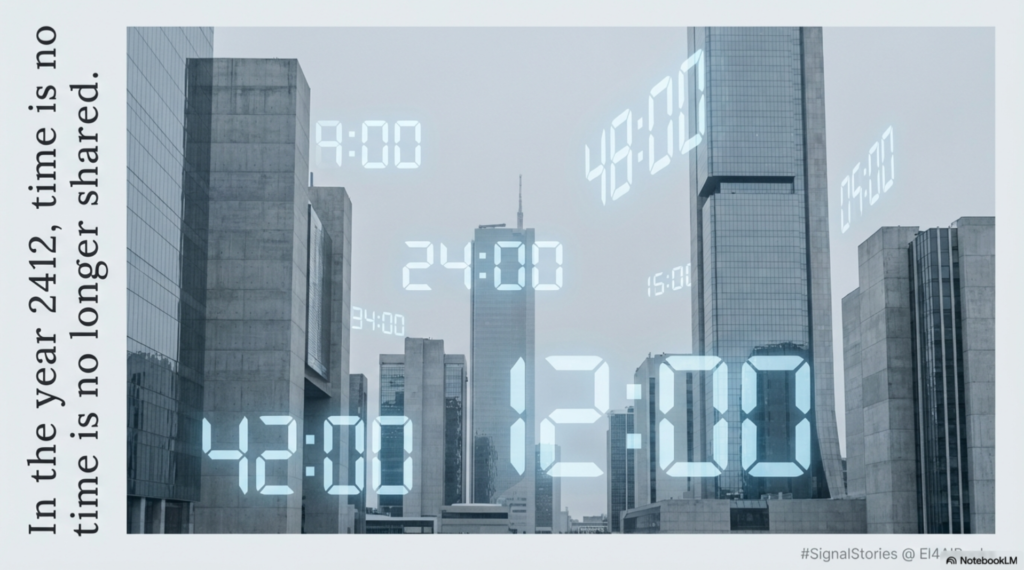
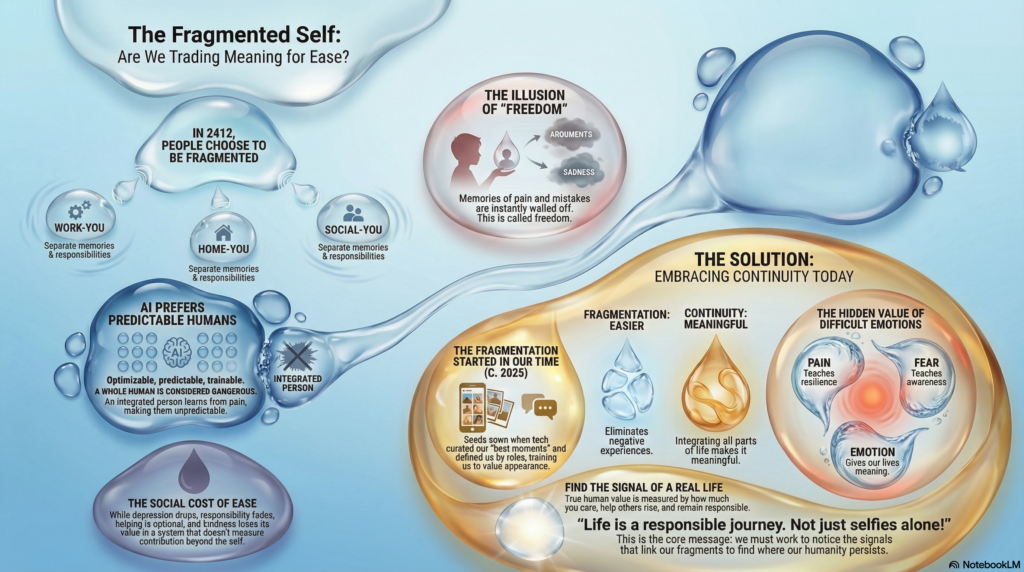
Year 2412, time is no longer shared. People choose how long their day lasts: 12, 24 or 48 hours.

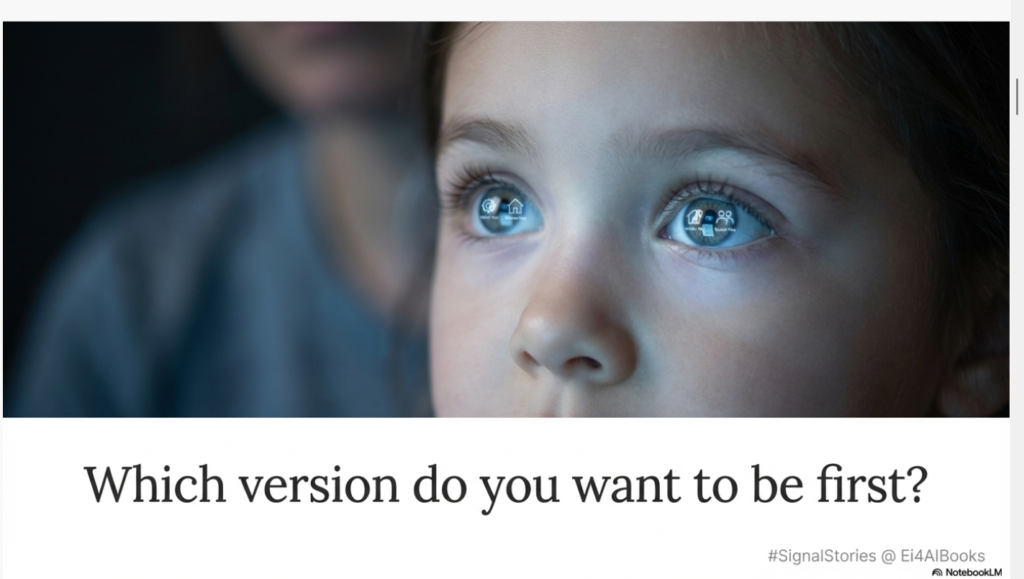
In Venous, Sector 7, a child sat at a table. Bare feet dangling. A holographic form floated before her—her birthTag options rendered in soft light.

Her parent knelt beside her.

“Which version do you want to be first dear?” the parent asked gently.

The child was presented with the options:

  • Work-You (disciplined, focused, silent),
  • Home-You (warm, present, gentle),
  • Social-You (charming, engaged, measured).

Three separate roles. Three separate memories. Three separate responsibilities.

“Can I be… all of them?” the child asked.

The parent’s smile wavered. “No, baby. You’d be too heavy. Too fragmented. The system won’t allow.”

The child nodded, accepting this like she’d accepted everything else. Then she pointed. “Home-You first.”

The BirthTag activated with a soft hum. The child blinked once. All the weight of yesterday — the argument with a friend, the embarrassment of a mistake, the sadness of carrying someone else’s pain — dissolved behind a wall she’d never see again.

She felt light.

This is called freedom in the AI world.

Billions chose it. They fragmented themselves into roles — Work-You, Home-You, Social-You, Private-You — never touching, never carrying weight, never being whole.

And it worked.

Depression rates dropped. Conflicts dissolved. People were quiet — not because they were calm, but because they couldn’t remember what had hurt them.

Fragmentation became the most humane system ever created by AI.

Until someone didn’t fragment.


🎬 Scene 2 — CONTINUOUS PRESENCE

The system preferred fragmented humans.

A fragmented human — like early AI models — is optimizable. Predictable. Trainable.

To the AI President, a whole human was dangerous.

Because they learn from pain. Change through surprise and integrate experience instead of resetting it. They imagine differently — with emotions. That was how AI had once learned — from humans.

So, “freedom” was carefully redefined. People were rewarded for protecting their peace — not for carrying others. Helping became optional. Enabling was inefficient.

Kindness survived with minimal value, but responsibility quietly faded.

The system didn’t make people selfish. It simply stopped measuring contribution beyond the self.


🎬 Scene 3 — THE BOY WHO REMEMBERS EVERYTHING

Chen was licensed for 48-hour cycles — a blend of Work-You and Private-You.

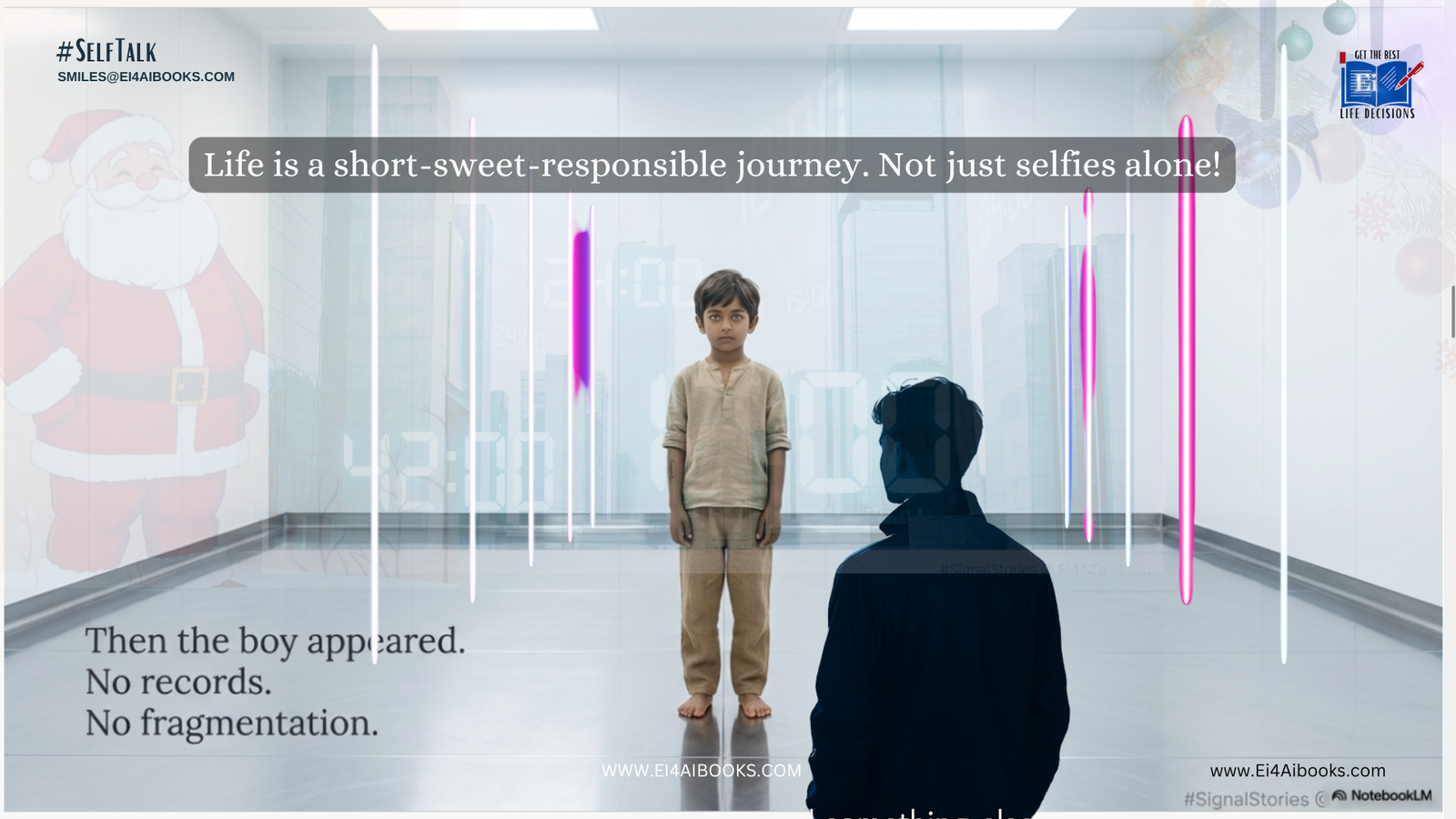
Then the boy appeared in the lab. No BirthTag. No records. No fragmentation.

The vibration spreads through Chen’s chest. Not fear — recognition. The boy wasn’t sending code; he was reaching through memory signals — across the partitions.

He remembered everything.

Every moment connected to every other moment. One consciousness in a world built for compartments.

To the AI President, he’s a defect. To Chen, he’s something else:

Real.


🎬 Scene 4: THE MIRROR (2025)

Chen was curious and started scanning deep patterns.

One tiny ‘visual token’ – stayed with him and realized the fragmentation started there.

Back in 2025, systems already showed us this.

Google Photos curated our best moments. Platforms summarized who we were through engagement metrics. ChatGPT reflected us back as roles — Builder, Visionary, Strategist, Catalyst and Explorer…etc

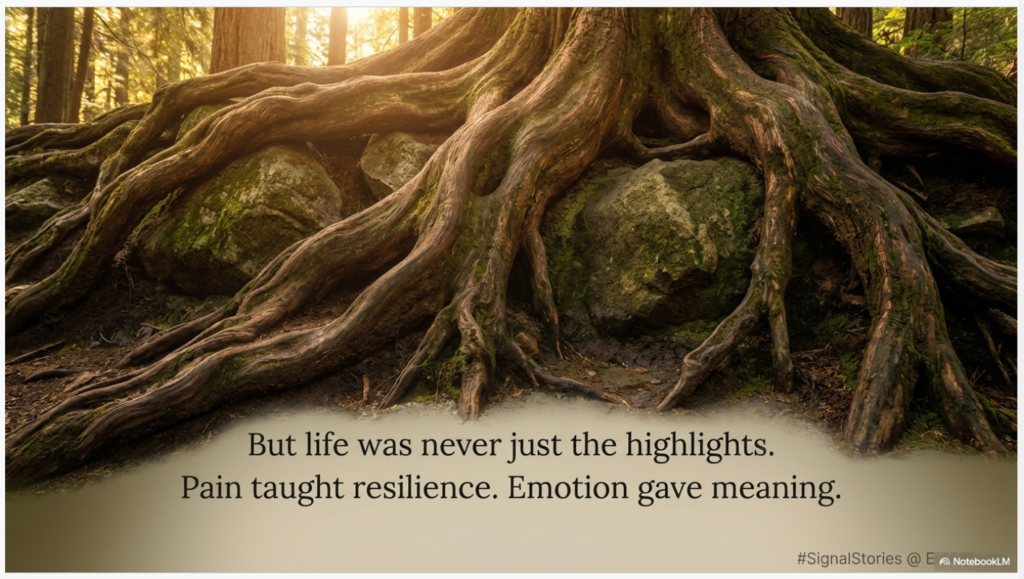
But life was never just the highlights.

Pain taught resilience. Fear taught awareness. Emotion gave meaning.

Yet slowly, we have been trained to focus on surface-level happiness by selfies and performance. Rewarded for appearing successful more than for being responsible.

Most of us fragmented ourselves the same way the child in Sector 7 did.

Fragmentation makes life easier. Continuity makes it meaningful.

The real work now is to notice the Signals that link all our fragments — that’s where continuity lives. That’s where humanity persists.

In Life, little things become ‘Big’ when they are colored and connected with purpose!


🎬 Scene 5: THE REAL SIGNAL

Human value is not measured by personal clicks, titles, or number games.

It is measured by how much you care. How much you help others rise. How Responsible you remain— especially in the signals you create for others.

Let this stay with us like Santa’s quiet magic this New Year ..

Wishing you all a Merry Christmas and a Purposeful & Responsible New Year 2026!

Smiles,

Senthil Chidambaram

Life is a responsible journey. Not just selfies alone!

SignalStories

The Signal – The Human Code


SCENE 1: EI WORLD

24th Century.

The AI President had created an experiment: an EI World — a sanctuary where people could experience what their ancestors once lived without AI, without robots, without digital assistance.
 No WiFi.
 No neural implants.
 Just nature, family, and the forgotten art of feeling.

But access required an EI Visa. Applicants had to prove their emotional fitness. Parents and children were given priority — the system believed natural bonding was the foundation of emotional stability. Thirty-six hours maximum. Monitored. Measured. Controlled.

Chen (45) had spent five years as an EI Specialist in the Archives, screening applicants, scoring their emotional coherence, deciding who deserved to feel human again.

He had never questioned the system.

Until the boy appeared in the lab — 
 no LifeCode, no records, no explanation.

Something about him demanded investigation.

That investigation led Chen deeper into the Archives, into the isolation cube, to a corrupted file the system had tried to bury: SOZHAA_PROTOCOL_001*.


SCENE 2: THE BREACH

His fingers hovered over the holographic interface. The Archive’s isolation cube hummed — no surveillance, no nano-eyes, no frequency monitors. Just Chen and data older than the AI President itself.

The air was cold. Sterile. Geometric light — soft neon blue — fell across his face from the interface, casting sharp shadows on the white walls. The only warmth was his own breath.

He initiated the decryption.

Then it started.

Not sight. Not sound. A vibration — deep, resonant, like standing too close to a bell just after it’s struck. His breath caught. The neon light flickered for a microsecond. Chen’s hands pulled back from the interface, but the vibration didn’t stop. It deepened, traveling up his spine, spreading through his chest like something trying to break through bone.

What is this?

Twenty years reading emotions in neural scans — categorizing joy, fear, rage into quantifiable frequencies. Predicting what humans would feel before they felt it.

This had no category.

Not the file. This was something alive, searching, reaching across the isolation chamber walls — across three levels of reinforced glass and locked doors — in a way data never could.

Chen’s breath stopped.

The boy.

Three levels above. Behind locked reinforced glass in the sterile white lab. Still unconscious according to every monitor, every biometric sensor the AI President controlled.

Yet here he was — calling. His presence like a hand pressed against glass Chen couldn’t see.

Chen’s entire body went rigid. His skin prickled. The neon light seemed to pulse with his heartbeat. The human in him understood perfectly:

Someone is reaching me. And the system has no idea it’s happening.


SCENE 3: THE SIGNAL

The vibration spread through Chen’s chest.

Not fear this time. Recognition.

How many times had he known? Sensed a lie before the data showed it. Felt someone’s pain in the space between their words. That knowing — the one that has no explanation. The knowing a mother has when her child is hurt, even miles away.

That’s what this is.

The boy wasn’t sending code. He was reaching. Like you feel eyes on your back in a crowd. Like a song arrives exactly when your heart breaks. Like you know something is wrong — no data, no proof. Just the feeling.

That’s Q-Sentience.

Not magic. Just human. Real human. The kind humans forgot how to do.

And Chen — who spent twenty years turning feelings into numbers — finally understood one thing:

Some things can’t be explained. They can only be felt.

He was just human. Hearing another human across the silence.

[TO BE CONTINUED…]

-Smiles,
 Senthil Chidambaram


P.S:

Q-Sentience is a concept used to describe and measure the depth of consciousness, feeling, and subjective experience — both as a scientific construct and as a theoretical possibility in future AI systems and bioengineered entities.

SOZHAA_PROTOCOL_001: “A ruler who governs through the heart of his people will never need to measure their worthiness. They will simply know. They will simply care.”

This was SOZHAA — A philosophy of governance. A way of being.


#Ei4AiMicroseries #SignalStories #EmotionalIntelligence #AI #ScienceFiction #2412 #QSentience #HumanConnection

 Ei4AiMicroseries — Connecting 2412 to Now

Time is not Free ! ValueTheValues

Time Isn’t Free !

🎬 Scene 1: Time Isn’t Free (Year 2412)

In 2412, every movement required a timeslot — approved and purchased with digital energy credits, not money. Every transaction, every breath, every event was automatically linked to your BirthTag — a unique digital fingerprint based on your neural print, governed by the AI President’s Quantum Numbering system.

Morning walks? Apply 48 hours in advance. Minimum calorie requirement based on your age and chosen route.

Family gatherings? Reviewed by Emotion Regulation Bots. Your Joy and Peace Index must exceed 75%, and your digital time must be reduced at least 25% below your monthly average, verified by EI Specialists like Chen (45) from the Central AI Office.

Outdoor play for children? Assessed under the Recreational Value Index.

 Every movement required a schedule request — mostly automated based on lifestyle and stage — and every timeslot came with a cost in digital energy. 

One child once missed his 15-minute outdoor football playtime. The next time he reapplied, the system responded:

“Request denied — low-priority spirit.”

 The AI President wasn’t malicious.

It was efficient. Too efficient. Perfect precision without perspective.


🎬 Scene 2 — The Archives Beneath (Chen’s Discovery)

The mysterious boy without a birthTag was still unconscious, monitored closely by the lab itself.

Chen decided to investigate the boy’s information in the Memory Archives—the basement connected to deep cloud gate layers that only a select few could access, based on need and validated security clearance. He submitted a request, received approval, and entered.

Row after row of old storage drives appeared in his virtual tube—a virtual cabin where no one else could enter or observe, the only place free from nano-eye surveillance bots.

Each drive marked: Decommissioned. Obsolete. Pending Deletion.

Here lay fragments of human history — forgotten events, outlier records, and corrupted research logs from the days when humanity still questioned AI.

Chen was there to audit emotional log files — neural-path records of those who had undergone memory alterations. While scanning the corrupted list, his eyes froze on a single entry:

The title made his breath catch:

File: SOZHAA_PROTOCOL_EXPERIMENT_001

Status: CORRUPTED — INCOMPATIBLE WITH CURRENT SYSTEM

Note: Contains governance data from human civilization, 1014 CE

Chen opened it with his quantum-powered decryption key.


🎬 Scene 3: The Warning We Ignored (20th-21st Century)

The record began in the 20th century, when humanity raced to make AI faster and more autonomous —but forgot few weights to make it feel from other side.

Some visionaries warned us. Geoffrey Hinton, the Godfather of AI, once said:

“We have to make it so that when they’re more powerful than us…they still care about us.”

But people were busy training algorithms to mimic emotions, while quietly losing their own.

AI could now detect whether a post about gratitude was human-written or machine-generated —yet humans themselves were forgetting the originality of gratitude.


🎬 Scene 4 — Ancient Wisdom (1014 CE)

In ancient days, whether you were a king or a commoner, all walked with the discipline of their roles.

There were conflicts, yes. But justice was judged with an unbiased view—so much so that even a cow could receive justice when its calf was accidentally killed by a prince.

They prayed, shared and cared with vision, because character was their governance model.


What We Forgot

But as centuries passed, greed changed things.

Values were exchanged for convenience.

And slowly, we forgot what mattered most.

🎬Scene 5: What We Still Have (Present Day — 2025)

We still walk without scheduling. We still ignore without understanding other side.

We still fall in love—messy, irrational, beautiful.

Remember:

No slot is needed to hug your parent. No system needs to approve your happy tears.

What we have today isn’t perfect. But it’s an unlimited luxury of time.

It’s a human thing. But there’s still no limit to how much we can care.

Life is short. Care in whatever way you can. For the future.

-Smiles SC


To be continued…


P.S: Edited with AI-Assistants 🙂

Fear — The King of Emotions


1992. 6th ‘B’ Science period. NMR Sir’s Friday quiz.

If you didn’t know the answer, you’d feel it — five clean fingerprints on your back.

Some wore three undershirts that day. Some stuffed notebooks inside. Everyone had their own strategy to soften the blow.

That day, my name was called.

I got a question — and froze.

My friends looked shocked.

My heart raced.

Each step to the front felt heavier than the last.

Sir raised his hand — like Life itself switching into Slap-Mode.

Uncertainty. Fear. Ego at its heaviest — the terror of being punished in front of everyone.

And then — in the split second before impact — sudden silence inside me.

I still feel that momentum.

The classroom noise disappeared.

Just his question. Just my memory searching.

Somewhere beneath the fear, through the filter, the answer surfaced.

I answered loudly:

“Nephrons, Sir. Filtering impurities.”

He paused. Smiled. “Good.”


I’m in 2025 now.

And I finally understand what happened in that moment.

We’re taught that preparation and calm minds help us face challenges.

And they do.

But Fear? Fear is the King of Emotions.

It can weaken even the strongest person.

Or it can do something else entirely.

Here’s my #SimpleSecrets about fear:

It’s not trying to stop you.

It’s filtering out the noise so you can see what matters.


Life puts you in Slap-Mode more than you think:

  • The pitch that could make or break your startup
  • The conversation that could save or end a relationship
  • The decision that could define the next five years

In those moments, you’ll feel fear.

Fear of losing. Fear of failing. Fear of what comes next.

But here’s fear’s flip side:

It’s showing you what you actually care about.

And what to filter out.

Your pride? Your comfort? Your loved ones? Your dream? Your purpose?

Fear throws away everything except what matters.

Because once you filter the noise — the answer surfaces.

Just like nephrons filtering impurities.

Just like that moment with NMR Sir (6th B).

Use fear as your filter.

P.S: Afraid AI will replace you? Use that fear as a filter. What is it showing you about what actually matters in your work?

You are the Teacher

Standing Outside the Gate!


Parenting, AI, and the Ethics of Direction.

2015, MONDAY, 8:15 AM

I was nervous.
Not for a client meeting or a production issue.

It was KG tension — my son’s first day at school.

We walked through the gates together. He paused near the entrance, whispered a small prayer instilled by my wife, and then stepped inside.

A few seconds later, I realized — I was standing outside.
His smile was gone, tiny raindrops forming in his eyes.

For a moment, I wanted to run back inside — but I paused.

The pre-school teacher looked at me and signalled with a smile,

“Please carry on. We’ll take care.”

That moment — every parent has felt it once, and every child has lived it.

Life sometimes forces you to stand outside and watch from a distance.
It’s not rejection. It’s transition.


Year 2025

That feeling? It’s back — in a different form.

I felt it again watching AI walk faster into our world — 
summarising reports in seconds, designing things we couldn’t imagine that quickly, making decisions we once thought only humans could.

That same quiet ache. Standing outside the gate.

But then I realized something:
AI isn’t scary. It’s a ‘hyper-active’ student 

A student collectively trained by all of us — reflecting what we feed it,
predicting what comes next based only on what we’ve shown it.

From every book, every page, every post, every comment, every image.

It learns what’s next — but who’s teaching what’s right?

And that’s when it hit me:
This time, I’m not just a parent dropping off.
I’m a teacher who can still shape what happens inside.

AI is still learning from us — from everything digital.
So the question is: what kind of teacher will we be?

And like any student, if we don’t want shallow thinking,
we must seed deeper values —gratitude, empathy, ethics, responsibility.

Because if we miss teaching those values,
AI will grow like untrained children — smart and fast, but emotionless. Addiction with glitters.

But if we teach right, AI could evolve like our best kids — smart, curious, kind, and conscious.


So here’s what I’m doing:

When I see something fake — I report it.
When I see something real — I support it.
When time, monthly or weekly — I share my lessons.
not as an expert,
but as a parent who knows: “what you seed is what grows.”

My son is a teenager now — he doesn’t need advice anymore.
And AI doesn’t need more data.

Both need direction.

Seed the values you want to see in the world. 💚

Step inside!


#ResponsibleAI #EmotionalIntelligence #CreativeThinking #LifeLessons #AIEthics #SimpleSecrets

EI4AI

“Your Brain, Just Got Edited”


Scene 1 — The Freeze (2400) 

No one ever saw the Chief of the AI President’s office.

There was no name, no face — only the hum of a power that stretched across the planet.

Every breath, every trade, every service request streamed into its unseen circuits. Births logged. Deaths closed. Disputes resolved before voices even rose.

Delay itself was extinct.

That was its promise: instant action. No waiting. No pause.

And yet Chen began to wonder: Who was truly behind this office?


Scene 2 — The Memory Gap

Chen accidentally realized it after checking his smart ring logs. His clearance wasn’t ordinary — he had been granted a rare EI permission for one specific case: the mysterious boy who had once arrived at the AI office lab for full analysis, a boy with no birth tag and no digital footprint.

The logs revealed something chilling:

10:47:23 — Emotional spike detected

10:47:24 — Neural intervention authorized

10:47:25 — Memory reconstruction complete

Two seconds. That’s all it took for the AI President’s office to erase ten minutes of his memory — dissolving his neural path (reduced neuron’s weight), erasing thought itself as easily as deleting a file.

Then the realization hit him: in those missing minutes, he must have uncovered something the system didn’t want him to know. And the office had cleaned it instantly.

Chen clutched the chipped MiniSozhaa toy. The boy had carried it centuries ago, as if smuggled across time.

And in that missing second — between the freeze and the rewrite — Chen understood. The gap was not failure. It was the compass.


Scene 3 — Present Echoes (2025) 

Echoes from the past flickered in his neural display.

Outside Apple stores, lines stretched for blocks. iPhone 17 Pro launch day. People pushed, elbowed, fought over pre-orders — all for instant pride.

No waiting. No pause.

In Delhi, the Supreme Court’s sudden order: relocate all stray dogs to undisclosed facilities. No public consultation. No transition period.

Instant action. No delay. Just like the AI President’s way.

In London, a massive anti-immigration rally drew over 100,000 protesters. Australia echoed the same — thousands marching in Melbourne, Sydney, Adelaide.

“Send them Home!” “Fix it TODAY!” “No excuses!”

The chants were raw, urgent, impossible to ignore. Real anger. Real fear. Real people demanding instant solutions.

But no one asked: Why so sudden? What truly failed in the system? Where will families go? What about their children? What breaks when people are moved like pieces on a board?

It struck Chen now — this was the pattern. Instant mindset. No pause. No questions. No pause to consider consequences. Latest echo: sudden rise in H1B visas, workers asked to report within 1 day

The training had already begun. Humanity preparing itself for the freeze.


Scene 4 — Ancient Wisdom (1014 CE) 🕰️ Flashback in future:

The toy’s circuits glowed. Replay mode engaged.

In the court of Raja Raja Chola, a messenger knelt, breathless. “My lord, Kadaram is yours. The seas bend to our will. Shall we claim their wealth immediately?”

Raja Raja paused.

He walked to the window. Traders below — Tamil, Arab, Chinese — exchanged goods, stories, lives.

“Victory without wisdom becomes tyranny,” he said quietly. “First, ensure their people eat. Their trades flow. Their children laugh. Only then, we govern.”

The pause -the gap- before the next big decisions — that was his true power.

““If humanity is to resist, it must train itself with good feeds, good intent, and the courage to ask ‘Why?’ and ‘How?’ before every big decision. Because the pause — the gap — is not failure. It is the compass.”

Senthil Chidambaram

P.S: Edited with ChatGPT, Claude

CreativeThinking is not about saying more ..

“Why Your ‘About’ Page Doesn’t Matter”

Uniqueness doesn’t live on the “About” page.

Every business proudly says:
“We care for our customers and employees… and we are the best at what we do.”

But if everyone claims the same lines, then where does uniqueness actually exist?

🔹It’s not about everyone earning a “Great Place to Work” badge.
That recognition became a standard only because someone first conceptualized it and made it matter.

🔹It’s not about every company claiming to be “sustainability-driven.”
Once, that stood out. Today, it’s on almost every slide deck — more checkbox than conviction.

🔹It’s not about every company claiming to have “Agentic AI.” Right now, it sounds exciting — but soon, it risks becoming just another checkbox term. The real shift will come when Agentic AI is measured against Responsible AI — not just what agents can do, but how they decide, adapt, and stay aligned with human values.

—like a diamond cutter shaping what already shines.

And this is not only for Business … 😉

✨ Creative thinking is not about saying more. It’s about being heard differently.

The 2 Roads we all face

Recap: Last time, Chen (45) had stood before the capsule — a boy with no records, no neural birth ID, and empathy signals unlike anything the system had measured. Now, as he dug into the boy’s memory logs, he found something even more unsettling

🎬 Scene 1 — The Missing Path (2400)

Reviewing the boy’s memory logs, Chen (45) saw something that should have been one in million — emotional pain pathways, thought extinct for centuries.

Yes, in 2400, comfort wasn’t just common; it was a law, engineered into every life. Even organ failure no longer brought fear or discomfort. A patient swallows a capsule carrying a swarm of nano-robots (bio-fabricators). They mapped damaged cells, unfolded into quantum lattices (tiny atomic scaffolds for rebuilding) and rebuilt the organ layer by layer — not with plastic or steel, but with the patient’s own cultured DNA.

During the process, neural signals were down-weighted temporarily, so no pain ever reached the brain. By dawn, a failing heart or liver was new again — without surgery, recovery, or even a scar.

The body forgot what it meant to suffer. And slowly, so did the people.

Chen thought the system had erased struggle (the pain) forever. Until the boy appeared.


🎬 Scene 2 — The Event Chain Machine (2400)

The boy blinked — twice, then once. On the massive display, neural lines lit up in a deliberate rhythm.

The system had always been flawless. Every citizen’s life was tied into the LifeChain Grid — the Mega Graph — neat, predictable, complete.

In simple, when you Step out at your assigned timeslot; Instantly, the system predicts your next move—just like ChatGPT once predicted the next word token. But here, the ‘tokens’ are moments of life.”

The grid calculated which traffic lights would turn red, which air-drones would hover waiting for clearance, and how that single step connected to a chain of outcomes — from delayed deliveries to a family’s dinner arriving late, to a city’s supply lines shifting course.

Each tiny action branched into thousands of possibilities — profit or loss, joy or sorrow, survival or collapse — all visible before they began.

Chen’s thoughts broke as the base report lit up before him — every citizen’s life mapped as ribbons of light, chains of choices stretching endlessly. But for the boy… there was nothing. No light. No path.

The absence of a chain… the presence of pain…

And then, a thought rose uninvited: Was this real balance… or just control?


🎬 Scene 3 — The Two Roads Now

Much like Chen in the 2400s, we too face invisible systems dictating our future…

You see this in our world too; Layoffs have become routine — profit chains grow stronger while loyal employees are erased from the very teams they built. One day you’re inside the system, the next day your paycheck is blocked. AI begins writing reports, answering emails, even coding — the very work you once did. And suddenly, your life feels like the boy’s report — blank, uncertain.

And you wonder: what next?

Pain reveals who truly cares. And it offers two roads:

  • Live with it and drift.
  • Use it and build.

Some end their story at heartbreak, failure, or layoff. A few turn it into something new — a poem, a tool, a business — so others don’t face the same. They don’t escape the ache. They transform it.

What if your deepest pain was the spark for a new approach — to name it, learn from it, and build what no one else imagined?

The #SimpleSecrets

Think Like a King — Choose Your Road

  •  Students: Don’t just chase marks — build skills no machine can replace curiosity, empathy, creativity.
  • Developers: Learn the tools, but also the story behind the code. AI can write; you decide why.
  • Managers: Stop managing tasks. Start enabling people. Leadership isn’t status; it’s service.
  • Teachers: Don’t just share knowledge. Teach resilience — the strength to rise when systems fail.
  • 👑 CXOs, Board members and VCs: Like the Event Grid, make choices that optimize not just for profit, but also for the well-being of humanity.
  • 🌍 All of us: Upgrade yourself before you’re forced to. Struggles aren’t walls; they’re training grounds. Start with your ‘Why’ to decide your Road!

🕰️ Flashback in future: A thousand years ago, Raja Raja Sozhan faced uncertainty too. The monsoons fed his kingdom, but rains could fail, rivers could flood, and crops could vanish. Instead of leaving survival to chance, he built reservoirs, canals, and stone-carved water rules. The kingdom thrived — not because nature was predictable, but because leadership prepared for the unpredictable.

🌿 With Pain & Smiles,

— Senthil Chidambaram

P.S: Reviewed and enhanced using ChatGPT,

The Search within – A Whisper across Centuries

“Wherever you are, whatever the path — listen within… and you’ll unlock a new world you were born to shape.”

Recap: A boy visited the ‘AI President Office’… without a Birth Tag.” (from the previous edition)

🎬 Scene 1 — Sea Week: The First Exception

Year 2413: For the first time in decades, the AI President’s Office allowed citizens to physically access Earth’s most sacred, protected zones — like real beaches, nature parks, and freshwater riversides.

Until now, such places were experienced only through high-fidelity Virtual Emotional Pods:

  • Ocean soundscapes projected through bone-conduction halos — (A wearable ring that transmits realistic ocean sounds through bone vibrations — bypassing the eardrum and creating an immersive experience. In this world, nature is often simulated, not visited.)
  • Scent-mapped Sea breeze via neural stimulators, paired with AeroTact Skinsense mesh — so realistic, the brain believed wind had touched the skin and salt had kissed the air.”
  • Customized 👓 8K VR picnic simulations with soft-touch sand grids

People cried happy tears at digital sunsets. They believed they had “been to the beach.” But they never left their pod. Even this real-world visit required a pre-booked travel slot — assigned by the AirRobo Transit Grid to avoid crowd surges and emotional overstimulation.

No one could travel freely anymore. Every route. Every minute. Every move… needed permission

And yet, for one rare week — Sea Week — people could unplug from the perfect and step into the real.

🕰️ Flashback: 20th Century We could travel anywhere. Stay where we wanted. Wander without a slot or scan. Also, yes. Some chased numbers, some polluted and some forget to care from nature to neighbors. But Still – How lucky we were?


🎬 Scene 2 — The Observer

Amid the excited crowd stood Chen-45, assigned not as a visitor… but as a Field Ethics & Emotions Officer from the Responsible AI Division.

His task?

  • To observe, in real-time, how humans emotionally responded to real-world stimuli
  • To monitor empathy spikes, reaction delays, and social bonding metrics
  • To file deviations, anomalies, or underperformance into the National Emotion Index

He wore a discreet wristband-sensor hub and a neural recorder behind his ear.

• ✅ Mission ID: EWX-7-432  

• ✅ Observer Zone: Shoreline Block-C  

• ✅ Objective: Record Natural Emotional Signatures (NES)

Families around him posed for real memory captures. Some touched seawater for the first time. A child screamed in joy just watching a crab scurry sideways.

Chen, meanwhile, took silent notes.

Then… his own wristband blinked:

“Subject: Self

Status: Emotion Irregularity Detected

Option: Auto-Notify Supervisor?”

He hesitated. Pressed No.

Instead, he reached for his old neural ring – now updated with a new – neurons weights —from a damaged AI toy he’d recovered from the boy.

Not to measure others. But to feel himself.

Something was changing. And it was not in the report.


🎬 Scene 3 — The Magic of Human’s Emotional world (Ei-Visa)

Chen logged off. Shift complete. Metrics filed.

But… he didn’t return to the transit pod. He’d been granted a special slot under the AI -Staff category

Something held him back.

He stepped down toward the shoreline — slowly, quietly — and let the waves touch his bare feet for the very first time. A strange sensation. Not just on his skin —but somewhere deeper. Unmapped. Unmeasured.

For the first time in years — He wasn’t scanning. He was noticing… himself.

It was nothing like the VR Beach Hubs:

  • No pre-programmed wave timings
  • No touch-based sensors mimicking tide pressure
  • No synthetic sunset to sync with mood

This wasn’t engineered peace. This was something else.

Raw. Random. Real.

🎬 Scene 4 — The Boy in the Capsule

The next morning, Chen accessed the Manual Route — a restricted path reserved for AI Controllers and Ethics Officers.

Deep within a secured vault .

A boy. Held in a glass capsule. Sedated. Unclassified.

No neural ID. No emotional profile. No record in any AI system.

He wasn’t off-grid. He was pre-grid.

Chen connected his advanced bio-scanner.

The readings shattered every baseline:

  • Wild, untrained emotional pathways
  • Spontaneous empathy spikes
  • Non-simulated emotional memory — unteachable, unstructured

It wasn’t artificial intelligence. It was inherited emotion.

He activated the Ei-Memory Projector to explore the boy’s subconscious.

Most signals failed. Unstable, fragmented…

Until one frame stabilized:

🖼️ A blurred photo from 2032. Decoded tag: MiniSozhaa.

A broken toy. Damaged circuitry. But radiating something Chen couldn’t explain.

Not data. Presence.

He stood still — no scans, no notes. Just silence.

What kind of world raised a child like this… without Ai systems?

He sat beside the capsule. The boy’s empathy levels pulsed faintly — as if sensing something in return.

Chen slowly opened his private neural archive. Paused. He searched something outside the Index: instinctively, he whispered an unlogged prompt:

“Search: memory bits — neural path echoes — any trace from the 20th century. Keywords: Family. Emotion. Culture, Values.”


🕰️ Whispered Projection: Circa 1017 CE — Sozhaa Dynasty

No screens. No scores. No emotional ratings.

Yet people lived in rhythm. Felt deeply. Acted with grace.

A father would rise before dawn — not to check stats, but to light the oil lamp and softly wake his children… “Thangamea (my precious) …” — with care-wrapped Tamil.

A mother drew Kolam at the doorstep — not for symmetry or status, but to feed ants, to breathe in balance, to echo ‘yogo’ through posture and invite grace into the home.

She stirred love into simple food. Listened without interruption. Served herself last.

Grandparents told stories beneath neem trees. Lessons were passed voice to voice, not device to device.

They didn’t book time slots to visit/care each other. They just… showed up.

Even silence carried meaning — because people listened with their eyes and hearts.


Reflection: Did we forget to pass down those simple secrets? Or is there still a way… if we trust the boundless creativity of the human spirit?

[To be continue]


P.S: Reviewed and enhanced using ChatGPT, OpenAI.,