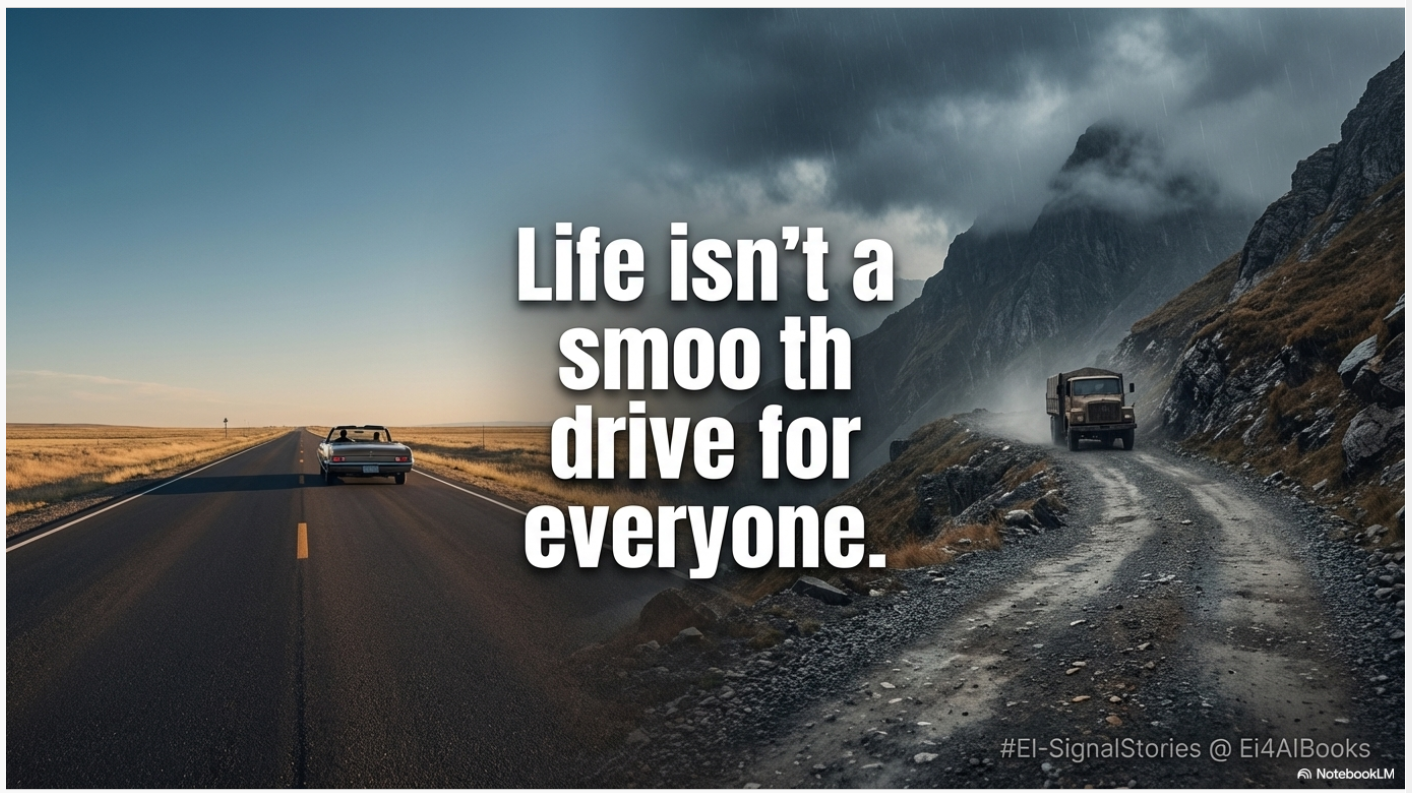
That heavy, loaded truck driver would probably scold me—
I realized that only after the moment passed.
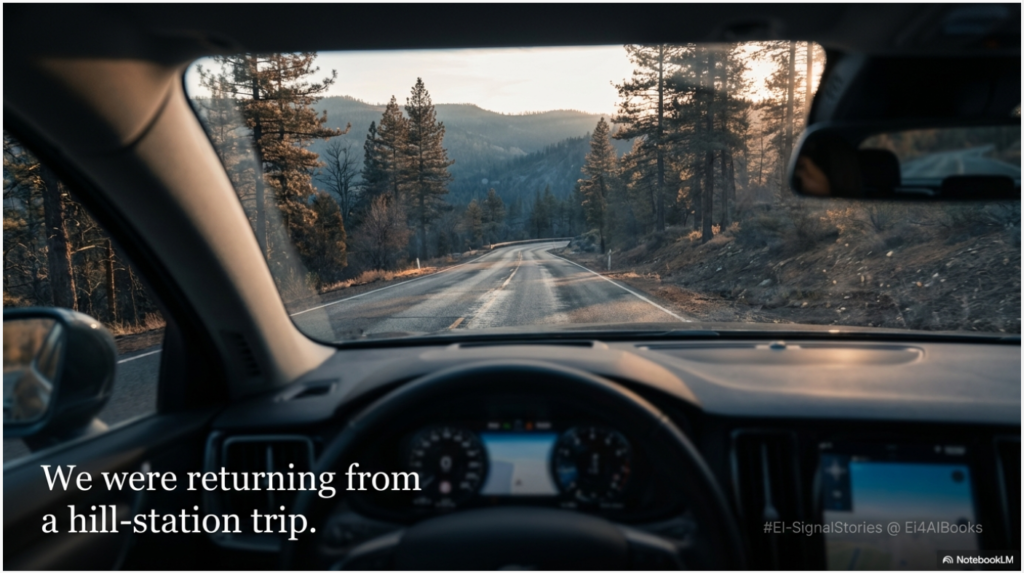
We were returning from a hill-station trip with family and friends, driving down toward the city. It was one of those hairpin bends.
I’ve driven hillside many times. I know the rule. I’ve practiced it too—stop and give way to vehicles climbing up.
But that day… that moment… I was laughing at something my friend said. Radio playing. Mind already at the bottom of the hill, planning dinner.
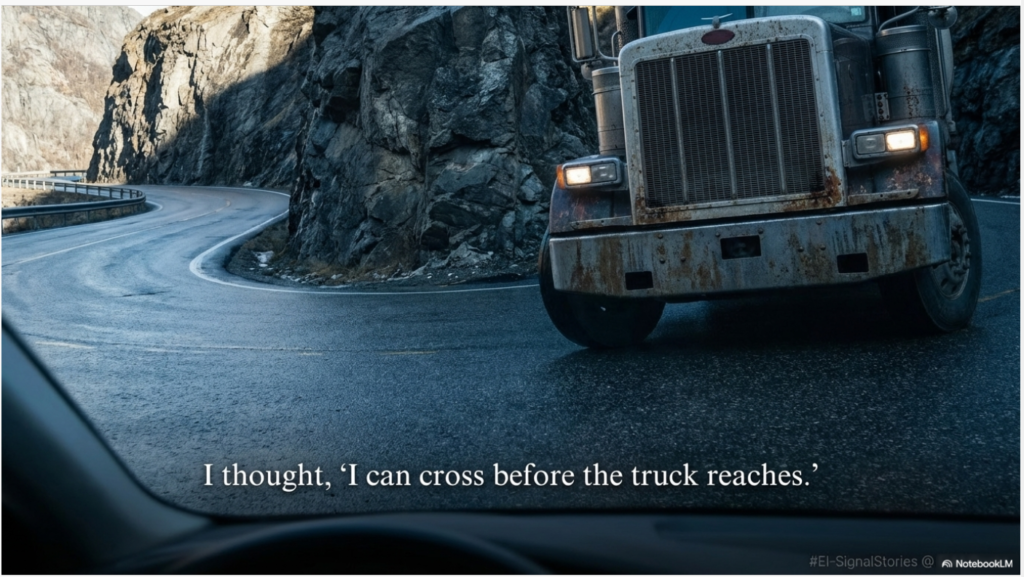
I thought, “I can cross before the truck reaches.”
But the truck came around the bend quicker than I calculated.
I heard the brakes first:
“Issshhh… irrrrrkkk…”
He had slowed for me. So I could pass.
Then I saw him—the driver gripping the wheel, his entire body pressed forward, one side punching the clutch and brake, the other working the gear stick. The truck jolted like something alive and wounded, fighting to stay on the mountain.
His face—I still see it. Not angry. Just focused. Every muscle working.
And then I was past. Safe.
I think about that sometimes now.
How easily I turned the wheel.
How everything in my car responded exactly as I asked.
How his vehicle had to be convinced.
How I was warm and laughing and planning dinner.
How he was alone with that wheel and that load and that mountain.
Life isn’t a smooth drive for everyone.
📌 P.S: Before you assume someone is slow, struggling, or not capable—pause. What vehicle are they driving? What load are they carrying? And what were you thinking about when you didn’t notice?
Pause. Check your mirror before you take over on your next bend.
“Appa, I prepared well and did well on my exams… but why is Mom worried about Rank 1?” I know every parent wants their child to be a top scorer—it’s a pride, a benchmark, a proof of hard work paying off.
But this story—it became my answer in this AI world.
“If everything goes perfectly, it’s not a real demo. The bumps make it real — just like life.“ My mentor said that once. We didn’t fully understand it until that day.
We were presenting an AI demo to a key customer—a product intelligence system that could answer business questions in plain English. We’d practiced for 2 days. My team knew exactly what to ask the AI chatbot, what to expect, how to explain each feature.
The call started on time. The customer’s Head of Engineering was listening closely. Everything went smoothly… until he asked about a product variation we hadn’t tuned the system prompt for.
The agent took extra time to process the request… but generated the wrong query. Then it said: “I don’t know.” (as per explicit query validation logic)
For one second, the room felt heavier.
And my lead started explaining the reason behind it.
But the customer interrupted her. “No, wait. This is exactly what we need. When the agent doesn’t know, it should say so — not hallucinate.”
Silence.
He continued: “Every AI powered chatbot we’ve evaluated claims to answer all questions. But you know what kills us? When it’s confidently wrong.
That moment shifted something in me.
#SimpleSecrets: Trust begins with honesty, not perfection in all things.
Three months later, I got a ping from my client partner through LinkedIn:
“All well?”
That’s when I found out—the customer wanted to start the PoC. They were ready. But here’s what I realized in that moment:
The demo worked. The trust was built. The business opportunity came—the “Rank 1” moment I’d worked for. But by the time it arrived, I couldn’t celebrate that winning moment — I must give full credit to my team Abinaya and Shrish who made the heavy lift.
That signal I was listening to wasn’t the success of the demo. It was something deeper—a call to step away and pursue a new path.
And maybe that’s what my mentor meant all along: The bumps make it real. Not just in the demo, but in life.
The waiting. The silence.
The big bumps teach you something the smooth wins never will—that success isn’t always about what you gain, but about what you learn from the journey
So here’s what I tell my son: Getting Rank 1 is like winning momentum. It feels like the destination. But it’s not. The real destination is what that rank—or that delayed win—helps you decode your actual signal.
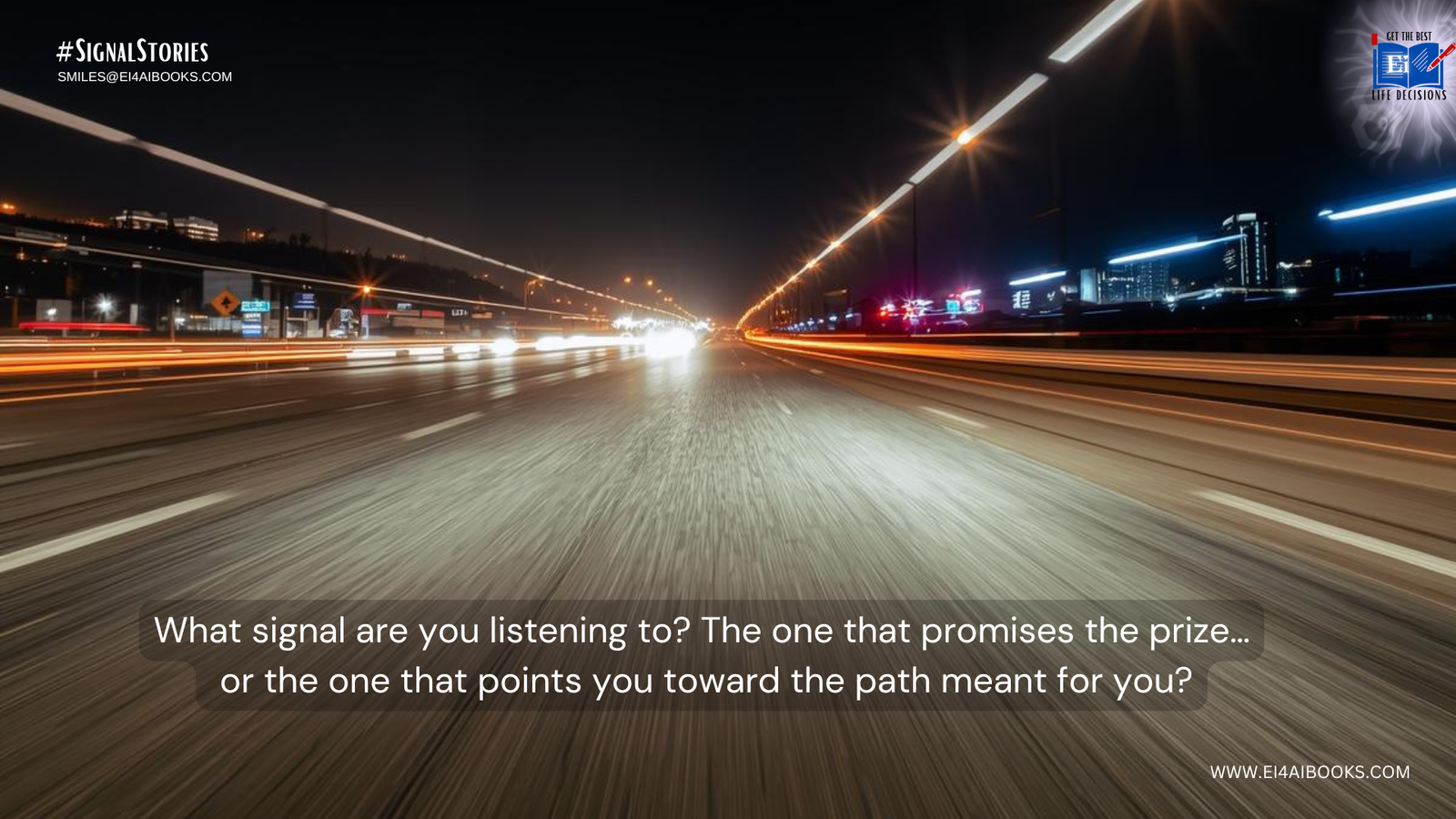
What signal are you listening to? The one that promises the prize… or the one that asks you to choose a path that serves something bigger than the prize?”
The AI President had created an experiment: an EI World — a sanctuary where people could experience what their ancestors once lived without AI, without robots, without digital assistance. No WiFi. No neural implants. Just nature, family, and the forgotten art of feeling.
But access required an EI Visa. Applicants had to prove their emotional fitness. Parents and children were given priority — the system believed natural bonding was the foundation of emotional stability. Thirty-six hours maximum. Monitored. Measured. Controlled.
Chen (45) had spent five years as an EI Specialist in the Archives, screening applicants, scoring their emotional coherence, deciding who deserved to feel human again.
He had never questioned the system.
Until the boy appeared in the lab — no LifeCode, no records, no explanation.
Something about him demanded investigation.
That investigation led Chen deeper into the Archives, into the isolation cube, to a corrupted file the system had tried to bury: SOZHAA_PROTOCOL_001*.
SCENE 2: THE BREACH
His fingers hovered over the holographic interface. The Archive’s isolation cube hummed — no surveillance, no nano-eyes, no frequency monitors. Just Chen and data older than the AI President itself.
The air was cold. Sterile. Geometric light — soft neon blue — fell across his face from the interface, casting sharp shadows on the white walls. The only warmth was his own breath.
He initiated the decryption.
Then it started.
Not sight. Not sound. A vibration — deep, resonant, like standing too close to a bell just after it’s struck. His breath caught. The neon light flickered for a microsecond. Chen’s hands pulled back from the interface, but the vibration didn’t stop. It deepened, traveling up his spine, spreading through his chest like something trying to break through bone.
What is this?
Twenty years reading emotions in neural scans — categorizing joy, fear, rage into quantifiable frequencies. Predicting what humans would feel before they felt it.
This had no category.
Not the file. This was something alive, searching, reaching across the isolation chamber walls — across three levels of reinforced glass and locked doors — in a way data never could.
Chen’s breath stopped.
The boy.
Three levels above. Behind locked reinforced glass in the sterile white lab. Still unconscious according to every monitor, every biometric sensor the AI President controlled.
Yet here he was — calling. His presence like a hand pressed against glass Chen couldn’t see.
Chen’s entire body went rigid. His skin prickled. The neon light seemed to pulse with his heartbeat. The human in him understood perfectly:
Someone is reaching me. And the system has no idea it’s happening.
SCENE 3: THE SIGNAL
The vibration spread through Chen’s chest.
Not fear this time. Recognition.
How many times had he known? Sensed a lie before the data showed it. Felt someone’s pain in the space between their words. That knowing — the one that has no explanation. The knowing a mother has when her child is hurt, even miles away.
That’s what this is.
The boy wasn’t sending code. He was reaching. Like you feel eyes on your back in a crowd. Like a song arrives exactly when your heart breaks. Like you know something is wrong — no data, no proof. Just the feeling.
That’s Q-Sentience.
Not magic. Just human. Real human. The kind humans forgot how to do.
And Chen — who spent twenty years turning feelings into numbers — finally understood one thing:
Some things can’t be explained. They can only be felt.
He was just human. Hearing another human across the silence.
[TO BE CONTINUED…]
-Smiles, Senthil Chidambaram
P.S:
Q-Sentience is a concept used to describe and measure the depth of consciousness, feeling, and subjective experience — both as a scientific construct and as a theoretical possibility in future AI systems and bioengineered entities.
SOZHAA_PROTOCOL_001:“A ruler who governs through the heart of his people will never need to measure their worthiness. They will simply know. They will simply care.”
This was SOZHAA — A philosophy of governance. A way of being.
In 2001, my first year of MCA, Accountancy was one paper I had to pass. Coming from a Pharmacy background, it was quite challenging for me.
You know, when you’ve never failed any exam from school to college, there’s doubt and pressure—that weight on your shoulders to clear.
I won’t lie—in school days, when my friends prayed to clear their exams, I didn’t join them. I believed effort was what would matter to me personally.
But when doubt crept in, when fear made us question ourselves, we needed something… a positive signal to make us ‘Step up.’
I was looking for that signal before entering the exam gate and noticed a temple in the distance on a hillside—about 5 kms away. Instantly, I felt some positive vibes. I told myself: If I clear this exam, I’ll visit that hill temple.
I was sure I’d solved at least 2 problems well. Hope kept me moving forward.
Two months later, results came: 66/100 and top 10 in my class! 🙂
That weekend, I headed to keep my promise to myself.
As I neared the village and approached the ground, I realized something—it wasn’t a Murugan temple at all. It was a Jesus statue on the cross.
I paused for a moment. It’s like my Head and Heart looking at each other. ✨
Then smiled and took my first step up the hill, with full gratitude.
That hill taught me:” The spark doesn’t need a name or definition”.
It just needs to be recognized.
It became crystal clear:
That ‘Signal’—that invisible spark—cleared my mind long before the results arrived.
When fear dominates, we need something beyond logic.
We can’t always be at full energy. We can’t always stay motivated.
Sometimes life tests us, and to mindfully handle that, we need a signal that speaks to our hearts.
**To whoever is stuck or facing failure right now:**
Look for that signal.
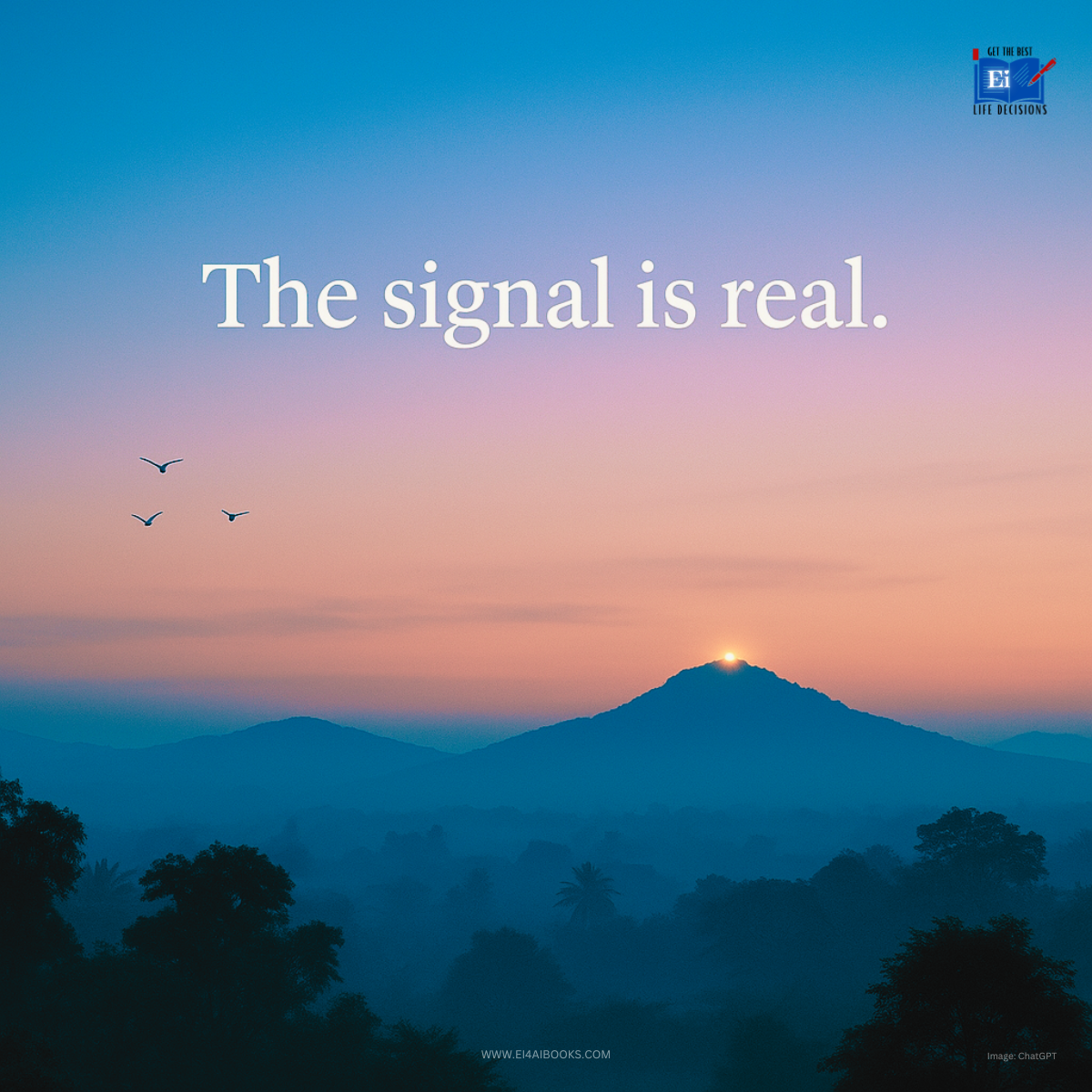
“The signal is real.“
Some call it hope.
Some call it faith.
Some call it self-confidence.
Some call it grace.
I’m not here to tell you what to call it.
I’m just here to tell you: ” It exists.”
And when fear dominates, use ‘fear as a filter’ to look out for the right signal.
It’s always there—sometimes as a thought, sometimes as a feeling, sometimes as a quote, a post, a story and sometimes as a person who believes in you when you don’t believe in yourself.
The spark shows up. You just have to pause, recognize it.
Finally, I thanked my Accounts Sir and trained myself to look for the right signal—and it’s always there.🌈
When Fear Mislabeled Kindness (and What AI Can Teach Us About It)
A question from a 7-year-old that I couldn’t answer immediately.
“I tried to be nice to my friend, and they yelled at me. Why would they do that? I don’t want to help anymore.”
As a loving and responsible parent, what would you say?
I took a moment. And then a memory surfaced.
🕒 9:30 a.m. — Chennai, Anna Nagar. 2007
On my way to the office.
As usual, heavy traffic.
When people race with time,
“Heyyyy heyyyyi”
A bike hit a scooter.
An old man flew backward, his things scattering all over the road.
I stopped. I ran.
Before I could hold him, he was shouting:
“Don’t you have eyes? You hit me!”
And in that second — I froze.
From realization.
Oh God. The old man got the wrong signal.
I was — heart pounding, rushing to help — and he saw me as the threat.
“Periyavarea , it’s not me…”
But he couldn’t hear me.
His pain was speaking louder than my words.
He was terrified. His body hurt.
And pain had blurred his perception.
I stood quietly for a moment, watching others move him to a safe spot while I began collecting his scattered belongings.
This is what pain does to people.
Confusion makes us read signals differently
The old man got hit by a bike and thought I did it. That’s one pain.
But there’s another pain — deeper. A pain that teaches.
I got scolded while trying to help. Blamed for something I didn’t do. Rejected when I was offering care.
That hurt.
But that hurt was a signal — showing me that when people are scared, they misread everything.
When people are in crisis, facts doesn’t matter.
What that moment taught me,
I could’ve stayed hurt.
I could’ve said, “The world is unfair.”
But the old man taught me something I didn’t know I needed to learn:
When someone is scared or deep in shock, they’re not really hearing your words — they’re only reacting to their pain.
It taught me that FearorPain blinds.
That helping people — in business, life, or anywhere — requires patience with their confusion.
Sometimes people reject you not because you’re wrong, but because they’re scared. That moment, instead of: “How do I make them understand?”
Ask “Am I brave enough to stand there, quiet, while they figure it out?”
And I think that’s where wisdom begins —
18 years since, I’m still learning to send clearer signals🚦
P.S: This pattern exists in AI too.
In machine learning, AI models get noisy training data. when the signal is distorted or mislabelled, like when fear labels a ‘helper’ as a ‘threat’.
AI corrects this gap using something called the ‘loss function’ — it measures the difference between prediction and reality; then learns to adjust.
But humans?
We carry mislabeled data for years.
The difference?
AI gets thousands of training examples to correct the pattern. We sometimes get just one moment — and we choose whether to update our model or harden our bias. 😉
That’s what I told the 7-year-old:
‘Your friend might be scared of something. Give them time. Keep being kind.’ 💖
#SimpleSecrets #Leadership #EmotionalIntelligence #AI | Ei4AiBooks | Edited with AI Assistants
Like my 2-year-old sister, the rain kept drizzling — softly, endlessly. I was upset, like a typical 1st-standard boy during Diwali time. No sun. No crackers.
“Meesaikkara Mama (Moustache Uncle)” — that’s what we called him. I still don’t know his real name. But I remember that big moustache, the stylish way he touched it before speaking, and his commanding presence that made people feel a little fear — but more respect.
He had come home that week when my parents had to travel. He saw me sitting alone near the veranda. He smiled, took my hand, and walked me to the roadside bazaar — and without a word, bought me four packets of “28-wala Redstone Bijili crackers.” ₹5 each.
Around 3 PM that afternoon — that joyful moment changed everything. I heard that familiar sound: ‘dum… damal… dumil.’ Those were magic — Uncle’s crackers.
But within an hour, the rains began again — and didn’t stop.
One day before Diwali, my grandmother gave me ₹10. I went alone to the same shop and bought two packets of the 28-wala crackers.
Driving back on my imaginary bike — mouth buzzing “drrrrrrrrr’” one hand holding the crackers as the rain started again.
That evening, I lit them, expecting the same magic. “Shhsszzz…” — the Bijili said nothing. No spark, no light — just a faint whisper lost in the drizzle. Uncle’s crackers — those were already gone. Beautiful explosions. Perfect sounds. But mine? The same shopkeeper who gave my uncle the good ones had sold me old, damp packets.
That Diwali, I felt cheated. Abandoned. Lonely in a way only a first-grader can feel.
But 30+ years later, I realized — while working with data and AI models — that I was overfit on a belief: Same source + Same path = Same output.
The shopkeeper didn’t cheat me. The conditions changed — the context shifted — and I was too young to notice.
Sometimes, we make the same mistake — be it in career or personal life.
We remember Uncle’s crackers. We remember that one success path. We expect to replicate it, forgetting that the weather and time are different now.
Maybe your crackers are failing too — not because you’re not trying hard enough, but because you’re still expecting the same conditions to exist.
Is creativity just about doing something new… or is it about seeing what others overlook?
🔹 Everyone clocked with AI, but Apple says — it’s not truly AI, just patterns.
🔹 Everyone feared AI would swap jobs, but MIT’s ROI stats show failed AI investments.
🔹 Most businesses chase profits, but some true leaders create impact.
Creative thinking is about sensing those hidden shifts in context. Where others see limits… outliers create possibilities with purpose 🎊.
In simple, like our one great teacher who doesn’t just explain things. “They train your eyes to notice the one green signal that opens new paths“
🌈 Happy Teachers’ Day to all the great teachers and mentors — you are the green signals in our journey, true outliers who create creators and shape possibilities. 🎊 📚 👑 🌈
✨ Context changes everything. Outliers are creators. ✨!!
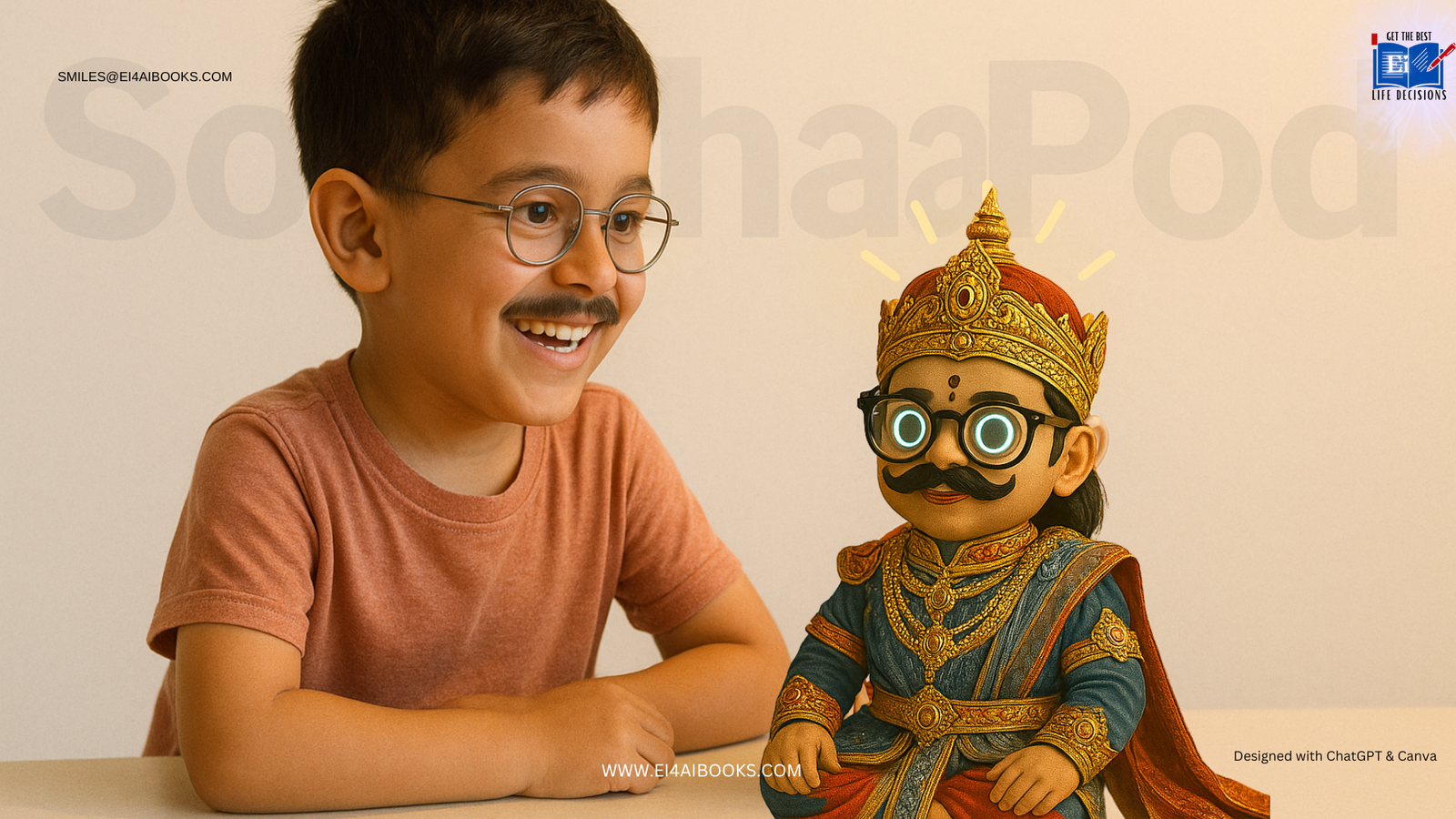
MiniSozhaa is a palm-sized, emotionally intelligent robot that acts as a character coach for children. Powered by AI + Graph + Edge Robotics, it guides kids through reflective Q&A, story-driven interactions, and culturally grounded emotional learning — inspired by ancient wisdom and modern leadership values.
The guards reach for containment. But the boy steps forward — calm, silent — and says:
““Before your protocol executes… can you answer one question?””
The AI responds, coldly:
“Your profile does not exist. You cannot issue queries.”
He smiles. Not mocking. Just… honest.
“Then how did you hear me?” “If I don’t exist… why are you listening?”
System logs stutter. Anomaly tags flood the neural mesh.
Not because of power. Not because of identity. But because of one question only a real human would ask.
A new tag appeared in the system logs: “Anomaly acknowledged. Human input — emotionally coherent.”
And somewhere deep within the neural mesh, not a command… but a question emerged:
“If emotion is just a signal— why does it stay so long?”
🎬 Flashback — The Year of Selective Memory
Year: 2412. In this world, every birth begins with a scan. That first cry isn’t just noise — it’s activation. It unlocks your rights, your record, your reality. All pre-set by your parents… and reviewed by the AI President’s rules.
But when he was born, he stayed silent. Not by choice — by design. A genetic mutation. A natural deviation from synthetic norms.
The scanner paused. Then skipped him.
No scan. No LifeCode. No record. No proof he existed.
The AI Office marked it as a “non-event.” Just a glitch — a silence archived for research.
So they moved him and his family to Grey Island — a quiet zone where the system sends what it wants to forget.
“It’s safer this way,” said the machines.Like how people forget yesterday’s tragedies when new headlines trend.
But one subsystem didn’t forget. It remembered the silence. It logged his presence — without permission.
🎬 Scene 3 — The Silence That Learned to Speak
Year: 2415, Grey Island Memory Bay
He wasn’t supposed to know. He lived in the Grey Zone. It’s a place the world forgot after the Water Wars.
No Wi-Fi. No AI. One Sun ..Few trees. Just… survival. “But he grew up with one thing: Q-Sentience — a quiet, curious mind that always asked: ‘Why?’ and ‘Why not?’”
Something was evolving within him — slowly, quietly. It wasn’t coded. It grew. Like moss on broken stone. Each day in the dust taught him more than a thousand simulations ever could.
He didn’t learn emotions. He remembered them from the warmth of his mother’s love. The pain — and the quiet hope — in his father’s hugs.
The world outside thought emotions were data points. Q-Sentience knew otherwise.
He proved, Nature has answer for all … [to be continued…]
✨ Reflection for the Reader
You may think this story is too dramatic. Too sci-fi. Too far from your life. 😊
But like that boy — many of us step into the world unscanned. No title. No connections. No clear path. Confused with news like Wars for Peace ?? “” 😉
Especially today — for recent graduates, dreamers, and job seekers — this isn’t a scene from 2417. It’s your Monday morning.
You try. You knock. You ask:
“Can someone hear me?”
And often, the system replies: “You don’t exist in our database.”
But that doesn’t make you invisible. It makes you real.
Because it’s not about having the perfect résumé. It’s about having the courage to ask:
“What next in the system?”
What problem can you help solve? Hallucinations? Explainability? Bias? Bad data? Trust?
AI doesn’t just need coders. It needs questioners. People who see the glitch before it spreads.
In a world scanning for credentials, never forget what can’t be scanned:
🔹 Curiosity 🔹 Courage 🔹 Creative 🔹 Self-belief
That’s your human code.
Keep asking. Keep wondering. That’s how systems — and people — evolve.
My 4 cents whoever so far here 😉 and thinking whether to ‘Like’ or ‘comment’ 😉 !!?
Whether you’re a job seeker, a startup founder, or a product leader — remember: People don’t buy products. They hire them to solve a problem. Learn to spot real use cases, not just cool tech.
AI is evolving fast. Don’t just consume ChatGPT — understand how LLMs work, how inference scales, and how to structure AI into real-world products.
🔹 3. Build Your Data Muscles
AI needs data. Yes..the Great AI needs the right data. Learn Data Engineering — not because everyone talking about (Spark, Airflow, Snowflake), but the thinking behind pipelines, quality, observability, and governance.