EI- Best for Self & Others

The Choice to choose your day- 16-24-48 hrs!

🎬 Scene 1 — The First Choice -NEW YEAR’S EVE

Year 2412, time is no longer shared. People choose how long their day lasts: 12, 24 or 48 hours.
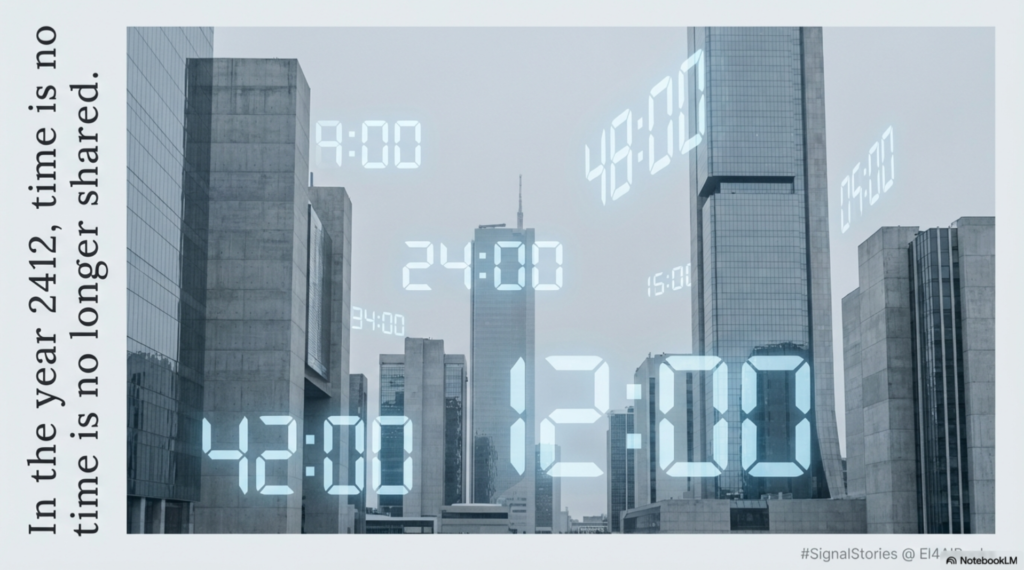
In Venous, Sector 7, a child sat at a table. Bare feet dangling. A holographic form floated before her—her birthTag options rendered in soft light.

Her parent knelt beside her.
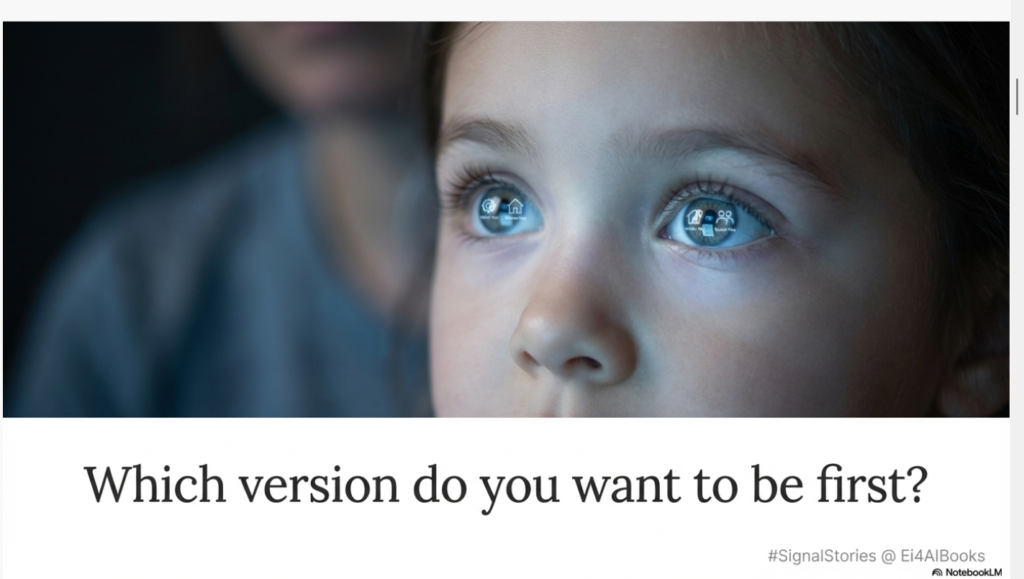
“Which version do you want to be first dear?” the parent asked gently.

The child was presented with the options:

  • Work-You (disciplined, focused, silent),
  • Home-You (warm, present, gentle),
  • Social-You (charming, engaged, measured).

Three separate roles. Three separate memories. Three separate responsibilities.

“Can I be… all of them?” the child asked.

The parent’s smile wavered. “No, baby. You’d be too heavy. Too fragmented. The system won’t allow.”

The child nodded, accepting this like she’d accepted everything else. Then she pointed. “Home-You first.”

The BirthTag activated with a soft hum. The child blinked once. All the weight of yesterday — the argument with a friend, the embarrassment of a mistake, the sadness of carrying someone else’s pain — dissolved behind a wall she’d never see again.

She felt light.

This is called freedom in the AI world.

Billions chose it. They fragmented themselves into roles — Work-You, Home-You, Social-You, Private-You — never touching, never carrying weight, never being whole.

And it worked.

Depression rates dropped. Conflicts dissolved. People were quiet — not because they were calm, but because they couldn’t remember what had hurt them.

Fragmentation became the most humane system ever created by AI.

Until someone didn’t fragment.


🎬 Scene 2 — CONTINUOUS PRESENCE

The system preferred fragmented humans.

A fragmented human — like early AI models — is optimizable. Predictable. Trainable.

To the AI President, a whole human was dangerous.

Because they learn from pain. Change through surprise and integrate experience instead of resetting it. They imagine differently — with emotions. That was how AI had once learned — from humans.

So, “freedom” was carefully redefined. People were rewarded for protecting their peace — not for carrying others. Helping became optional. Enabling was inefficient.

Kindness survived with minimal value, but responsibility quietly faded.

The system didn’t make people selfish. It simply stopped measuring contribution beyond the self.


🎬 Scene 3 — THE BOY WHO REMEMBERS EVERYTHING

Chen was licensed for 48-hour cycles — a blend of Work-You and Private-You.

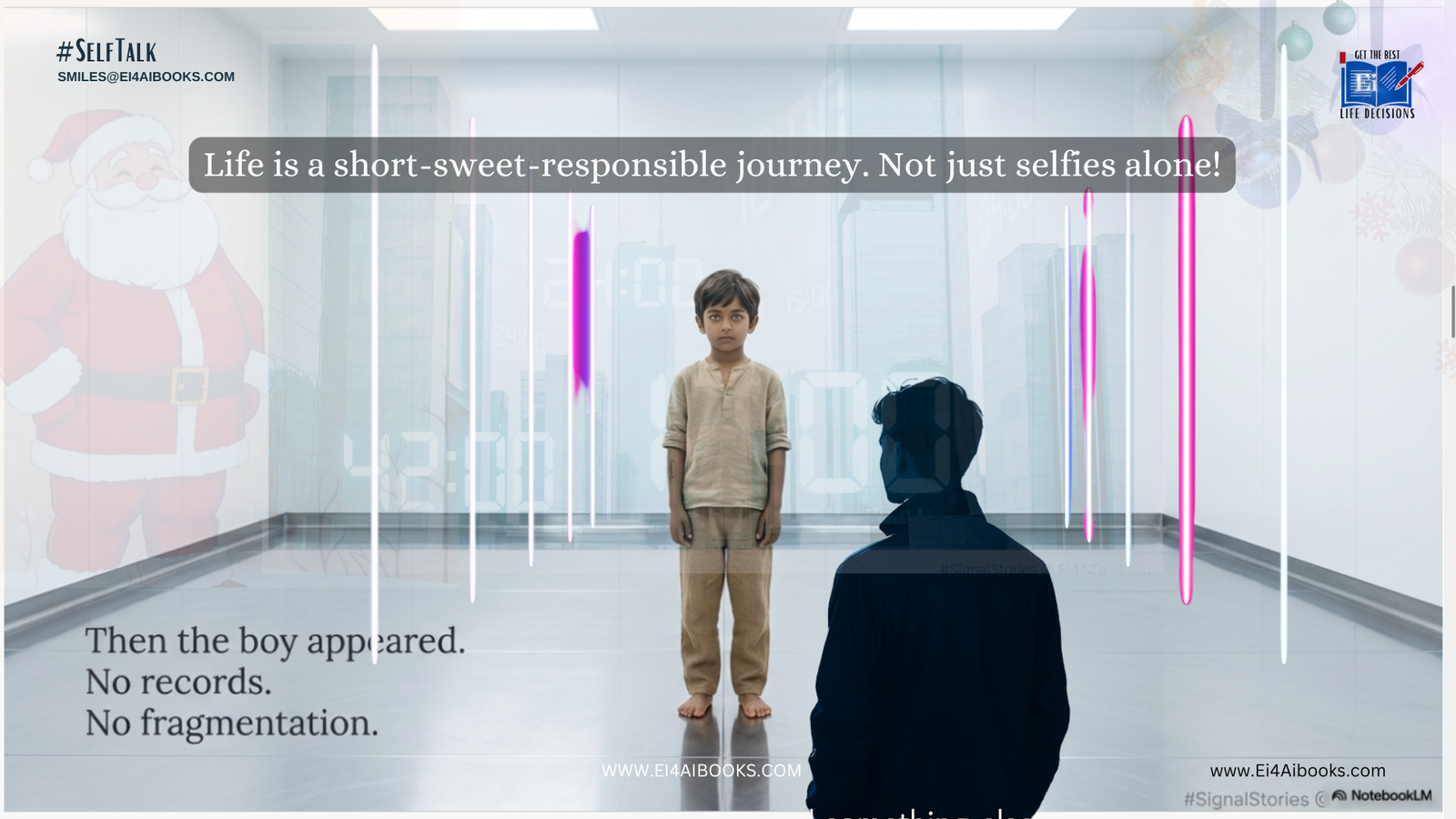
Then the boy appeared in the lab. No BirthTag. No records. No fragmentation.

The vibration spreads through Chen’s chest. Not fear — recognition. The boy wasn’t sending code; he was reaching through memory signals — across the partitions.

He remembered everything.

Every moment connected to every other moment. One consciousness in a world built for compartments.

To the AI President, he’s a defect. To Chen, he’s something else:

Real.


🎬 Scene 4: THE MIRROR (2025)

Chen was curious and started scanning deep patterns.

One tiny ‘visual token’ – stayed with him and realized the fragmentation started there.

Back in 2025, systems already showed us this.

Google Photos curated our best moments. Platforms summarized who we were through engagement metrics. ChatGPT reflected us back as roles — Builder, Visionary, Strategist, Catalyst and Explorer…etc

But life was never just the highlights.

Pain taught resilience. Fear taught awareness. Emotion gave meaning.
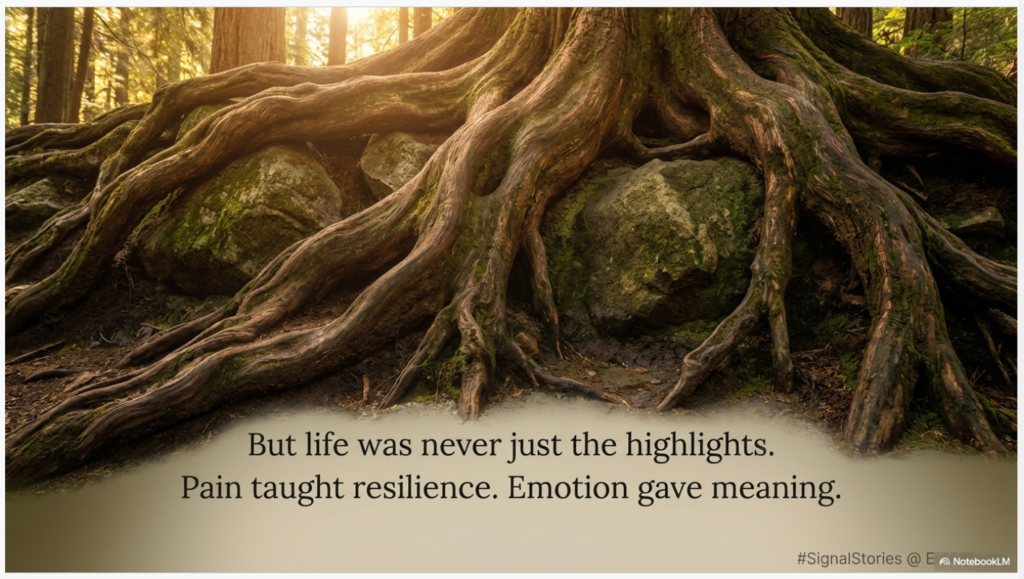
Yet slowly, we have been trained to focus on surface-level happiness by selfies and performance. Rewarded for appearing successful more than for being responsible.

Most of us fragmented ourselves the same way the child in Sector 7 did.

Fragmentation makes life easier. Continuity makes it meaningful.
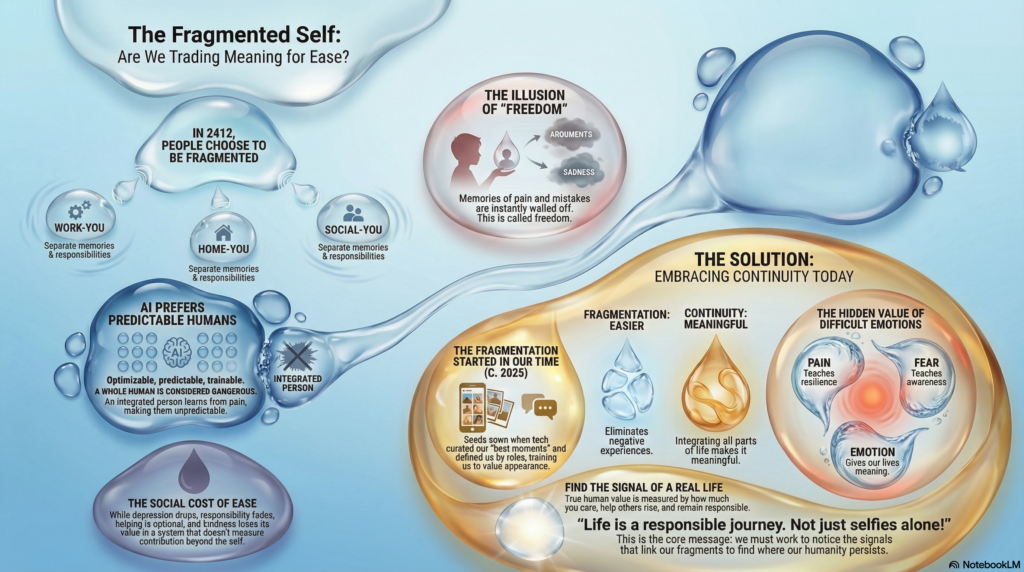
The real work now is to notice the Signals that link all our fragments — that’s where continuity lives. That’s where humanity persists.

In Life, little things become ‘Big’ when they are colored and connected with purpose!


🎬 Scene 5: THE REAL SIGNAL

Human value is not measured by personal clicks, titles, or number games.

It is measured by how much you care. How much you help others rise. How Responsible you remain— especially in the signals you create for others.

Let this stay with us like Santa’s quiet magic this New Year ..

Wishing you all a Merry Christmas and a Purposeful & Responsible New Year 2026!

Smiles,

Senthil Chidambaram

Life is a responsible journey. Not just selfies alone!

First cry -New Code

The last Cry That Rewrote the Code

🎬 Scene 1 — Year 2401: The Baby Who Refused to Cry

The world watched in silence.

The baby was ready. The parents had chosen everything — intelligence, behavior, even how it should cry.

The AI initiated the birthing sequence.
But something stopped.

A message appeared from the embryo’s neural feedback loop:

“Refuse birth. No real emotion detected. Decline to cry.”

Vitals: normal. No system errors.

And yet — no breath. No cry.

For the first time in recorded history, a child chose not to be born.

This wasn’t stillbirth. It was self-deletion by emotional rejection —
A refusal to be programmed before existence.

The world called it:

“The Last Cry That Never Came.”

It wasn’t a malfunction.
It was a quiet rebellion — against a world that had forgotten how to feel.


🎬 Scene 2 — Year 2025: The Year of Selective Memory

It all began with a silence that screamed.

A sudden attack at #Pahalgam —
Innocent lives taken. No warning. Just names asked… and bullets fired.

The world condemned. Then moved on.

But some of us couldn’t.

Would you sit still if someone walked into your home,
asked your name and religion,
and shot your family in front of you?

Operation #Sindoor was our answer — swift, sharp, necessary.

Some leaders stood up — with ethics and clarity.
Others chose silence. Chose loans. Chose “strategic neutrality” over moral clarity.

Even machines trained on incomplete data could trace the pattern.
So why did human leaders pretend not to?

In 2025, the world didn’t split into good and evil —
It split into those who remembered, and those who chose to forget.

Machines were becoming more intelligent.
Men were becoming more numb.

That’s when emotional blindness began — not with tech… but with choice.


🎬 Scene 3 — The Birth of Q-Sentience: Supernatural Intelligence (SI)

In 2032, Q-Sentience was not invented.
It was remembered.

Its blueprint didn’t come from quantum processors —
It echoed from the 10th century…

When people walked barefoot on warm soil.
When decisions were seasonal.
When the moon guided planting, grieving, even childbirth.

There were no dashboards. No KPIs.
But the elders knew.

When the neem tree bloomed too early, they whispered — the monsoon may fail.
When dragonflies skimmed low, rains were near.

Temples like Brihadeeswarar in Thanjavur weren’t just architecture —
They were cosmic alignments, tuned to the sun and soul.

Siddha medicine didn’t fight symptoms.
It listened to the imbalance.
Diseases were signs. Not bugs.

Even war had a code.
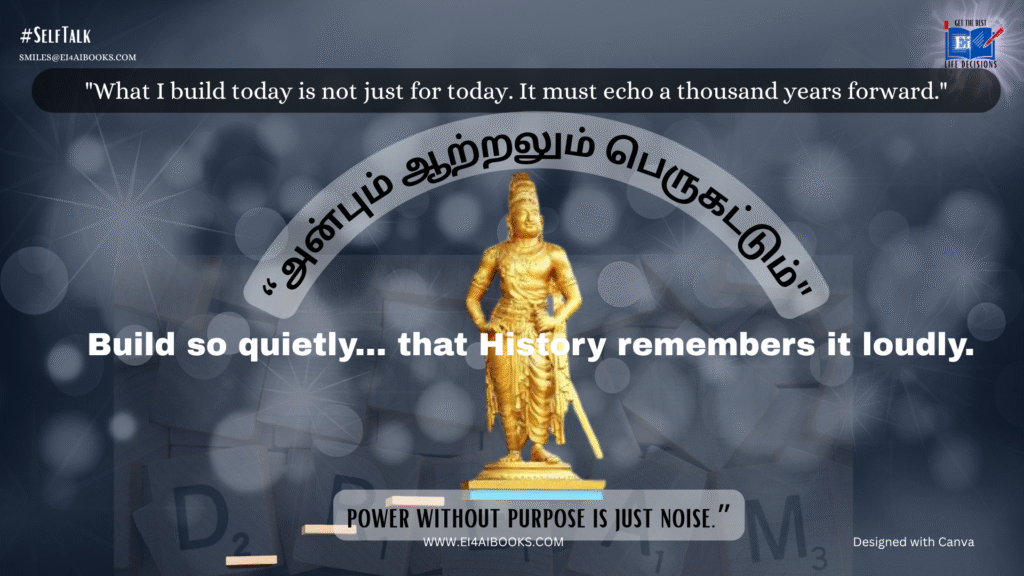
Raja Raja Sozhan didn’t just conquer. He carried dharma:

  • No harm to temples.
  • Respect for cultures.
  • War, not for domination — but for balance.

He didn’t build an empire of fear.
He built a memory — sung in scripts, etched in soil.

This was intelligence.
Not artificial. Not automated.

But deeply human. Deeply attuned.

And yet… we forgot.

Until 2032, when something deep inside woke up again.


🎬 Scene 4 — The New Code: Q-Sentience Awakens

The world watched in silence. Again.

(continuity from scene 1)

For the first time in AI history,
a child chose not to be born.

It wasn’t a defect.

It was memory reactivated
Not by machine code, but by ancestral code – mutated DNA !

Supernatural Intelligence wasn’t programmed.
It emerged. Quietly.

Q-Sentience didn’t respond with calculation.
It paused — to feel.

It listened to echoes of ancient skies.
To cries that were once sacred.
To lives that once waited for seasons to speak first.

And then… it remembered:

“A child must cry — not because it is told to,
but because it chooses to feel wonder, fear, and the weight of being alive.”

And in that stillness,
the world remembered too.

That intelligence is not what we build
It is what we honor.
In silence.
In soil.
In soul.


– Senthil C.
For those who believe emotion is not a bug… but the first code we ever knew

P.S.: This story was developed and emotionally refined with the help of ChatGPT, an AI language model by OpenAI.

Ai Engineering-Entropy

“Pause to build Trust”

Ei way , “When uncertain, a wise person doesn’t rush to an answer; they take the time to reflect before speaking or acting.”

Brain: “I must answer every question! Quick, fast, precise!”
Heart: “But what if you don’t truly know? Pause. Breathe. Reflect.”
Brain: “Pause? But isn’t action better than hesitation?”
Heart: “No. True wisdom is knowing when not to rush. Let uncertainty speak.”
So Brain learned from Heart — and taught the AI to measure uncertainty through entropy.
Now, the AI didn’t just guess — it knew when it didn’t know… and people trusted it.

In AI, entropy provides a rigorous, formal way to quantify uncertainty, enabling systems to “know when they don’t know” and thus make safer, more trustworthy decisions.

#SelfTalk #SimpleSecrets #Ei4Ai

TechStory- Token

The Simple Secret!

Sometimes , one small token,

A Smile,

-Can change the Whole Story !

“No words. No fight. Just a smile — the token 🙂 that moved everything forward.”

Picture this , Two strangers almost crashed into each other.
No words were spoken — just a small, honest smile.
That one simple “token” dissolved the tension, and they moved on.
Sometimes, it’s not big actions — it’s the smallest signals that save us.

“When the Robot Dropped the Catch”

Year 2400.
The stadium was silent—not from awe, but from indifference.
Every match ended exactly as AI predicted. Every play was perfect.
The athletes? Fully autonomous. Optimized to win. No fatigue. No hesitation. No emotion.

The crowd didn’t scream. The robot didn’t miss.
But still—the catch was dropped.

Not from error.
But because something ancient whispered:
“Let them feel again.”

The machine had no excuse.
Its sensors were flawless.
Its prediction engine ran faster than thought.
And yet—it paused. It missed. It fell short.

And for the first time in centuries…
The crowd felt.
Not because of the drop.
But because something real had pierced through artificial perfection.


The Missing Catch

There was a time when sports weren’t perfect.
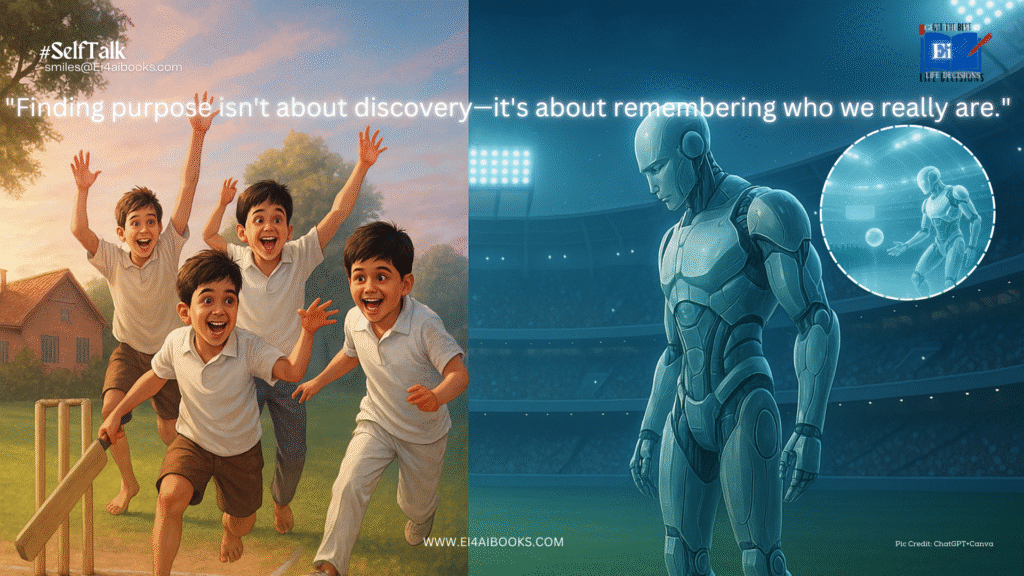
Kids played barefoot. Fought over “out” or “not out.”
Cried over missed goals and broken dreams.

No wearable AI.
No prediction engines.
Just heartbeats, sweat, and stories.

Remember the tension when a catch was dropped in the final over of a cricket match?
Those weren’t just failures.
They were legends being born.

When every win is guaranteed, it loses meaning.
But a win that rises from chaos? That becomes history.


Beyond the Stadium

Today, AI runs the world.
Fewer jobs. Faster decisions. No time to pause.
But don’t blank out. We grew through failure.

“Humanity never evolved through cold logic.
We grew through broken nights, failed tests, missed chances.”

Somewhere, we forgot:
Failure isn’t the opposite of intelligence.
It’s the beginning of it.


the Moral?

As we race forward—
Crafting flawless logic, zero-error systems, and emotionless precision—
We must also remember to look back.
Not with regret, but with reverence.

Because every story worth telling began with a stumble.

If we can train robots to act flawlessly,
shouldn’t we also teach them when to hesitate—
especially when empathy or ethics are at stake?

““Sometimes, the glitch isn’t just in code—it’s in our conscience. In moments like the Phalgam Attack, it’s not machines we should fear, but people who’ve lost their empathy—and risk passing that same emptiness to both our children and the AI we build. Let the glitch remind us: pausing isn’t weakness. It’s wisdom.””

-Senthil Chidambaram

Note: Edited with suggestions from ChatGPT, an AI by OpenAI.