EI- Best for Self & Others

The Choice to choose your day- 16-24-48 hrs!

🎬 Scene 1 — The First Choice -NEW YEAR’S EVE

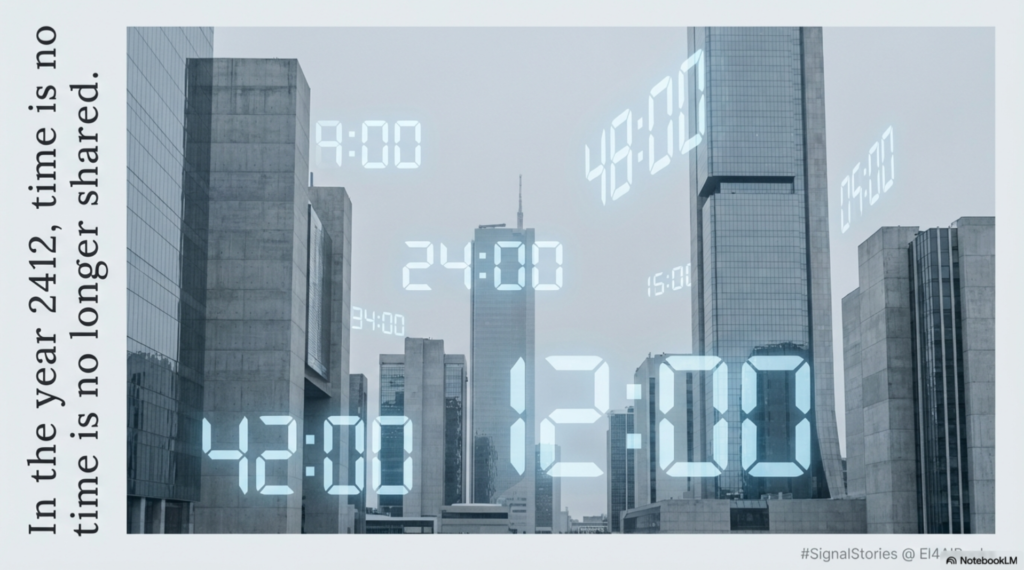
Year 2412, time is no longer shared. People choose how long their day lasts: 12, 24 or 48 hours.
In Venous, Sector 7, a child sat at a table. Bare feet dangling. A holographic form floated before her—her birthTag options rendered in soft light.

Her parent knelt beside her.
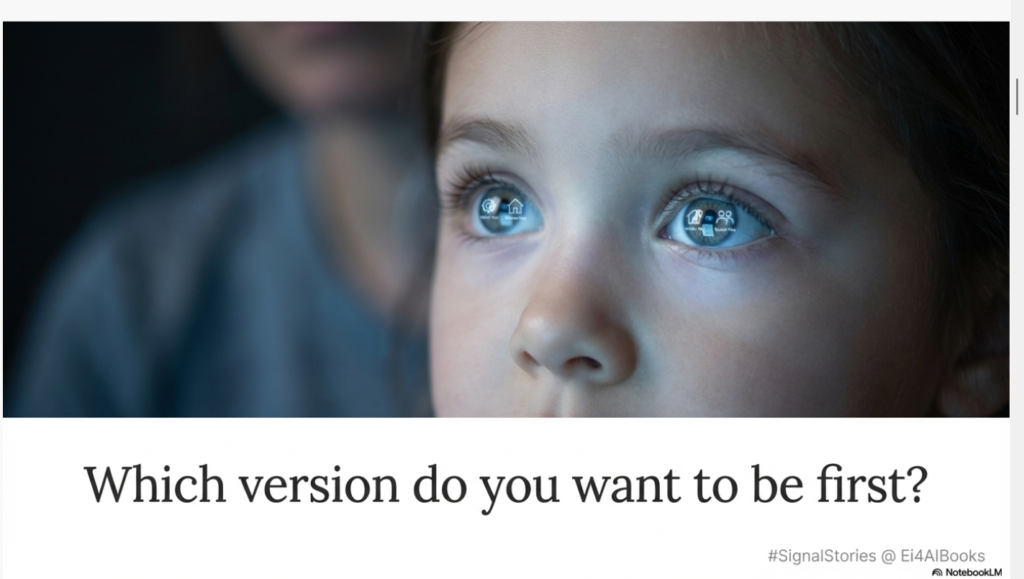
“Which version do you want to be first dear?” the parent asked gently.

The child was presented with the options:

  • Work-You (disciplined, focused, silent),
  • Home-You (warm, present, gentle),
  • Social-You (charming, engaged, measured).

Three separate roles. Three separate memories. Three separate responsibilities.

“Can I be… all of them?” the child asked.

The parent’s smile wavered. “No, baby. You’d be too heavy. Too fragmented. The system won’t allow.”

The child nodded, accepting this like she’d accepted everything else. Then she pointed. “Home-You first.”

The BirthTag activated with a soft hum. The child blinked once. All the weight of yesterday — the argument with a friend, the embarrassment of a mistake, the sadness of carrying someone else’s pain — dissolved behind a wall she’d never see again.

She felt light.

This is called freedom in the AI world.

Billions chose it. They fragmented themselves into roles — Work-You, Home-You, Social-You, Private-You — never touching, never carrying weight, never being whole.

And it worked.

Depression rates dropped. Conflicts dissolved. People were quiet — not because they were calm, but because they couldn’t remember what had hurt them.

Fragmentation became the most humane system ever created by AI.

Until someone didn’t fragment.


🎬 Scene 2 — CONTINUOUS PRESENCE

The system preferred fragmented humans.

A fragmented human — like early AI models — is optimizable. Predictable. Trainable.

To the AI President, a whole human was dangerous.

Because they learn from pain. Change through surprise and integrate experience instead of resetting it. They imagine differently — with emotions. That was how AI had once learned — from humans.

So, “freedom” was carefully redefined. People were rewarded for protecting their peace — not for carrying others. Helping became optional. Enabling was inefficient.

Kindness survived with minimal value, but responsibility quietly faded.

The system didn’t make people selfish. It simply stopped measuring contribution beyond the self.


🎬 Scene 3 — THE BOY WHO REMEMBERS EVERYTHING

Chen was licensed for 48-hour cycles — a blend of Work-You and Private-You.

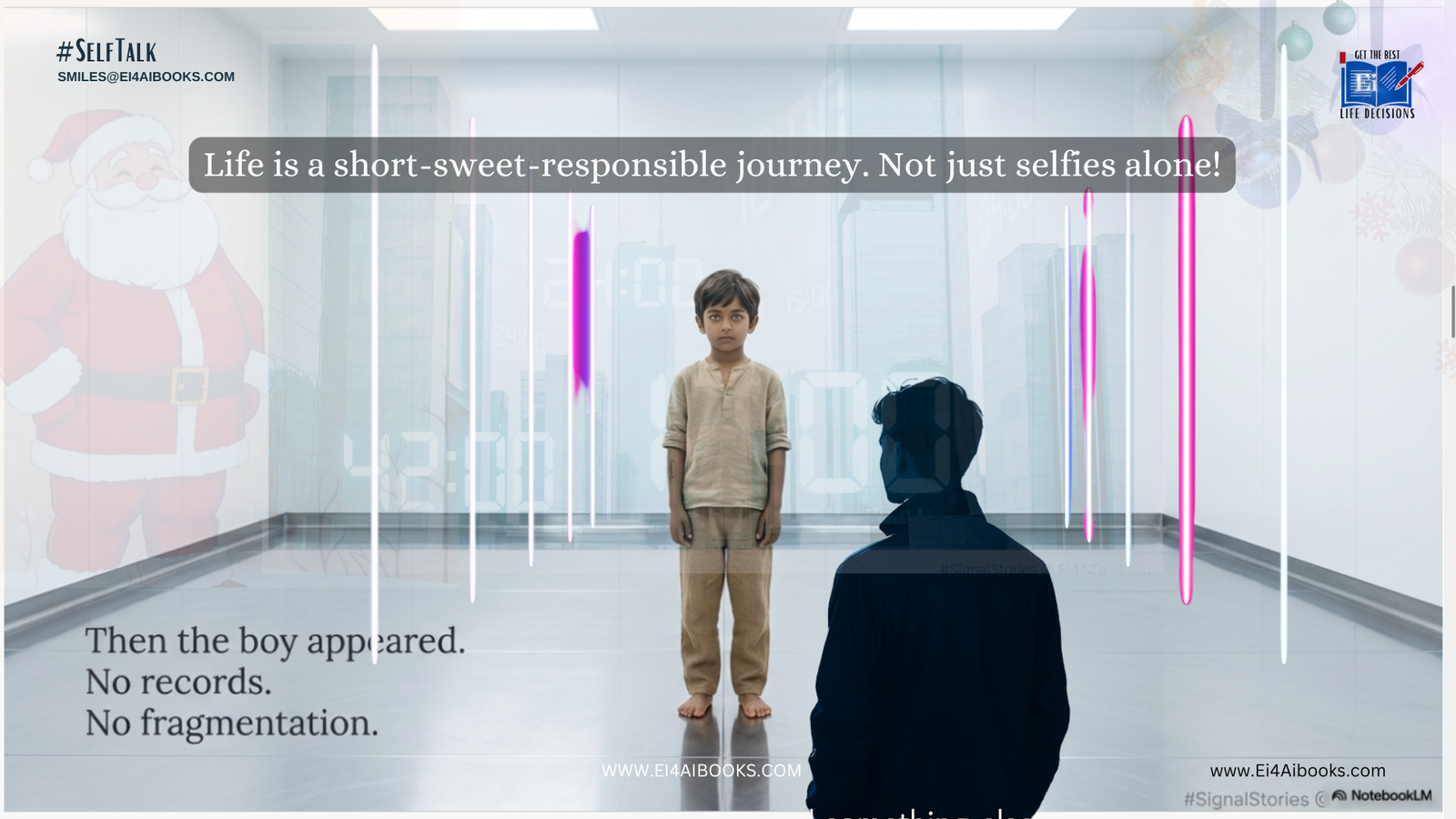
Then the boy appeared in the lab. No BirthTag. No records. No fragmentation.

The vibration spreads through Chen’s chest. Not fear — recognition. The boy wasn’t sending code; he was reaching through memory signals — across the partitions.

He remembered everything.

Every moment connected to every other moment. One consciousness in a world built for compartments.

To the AI President, he’s a defect. To Chen, he’s something else:

Real.


🎬 Scene 4: THE MIRROR (2025)

Chen was curious and started scanning deep patterns.

One tiny ‘visual token’ – stayed with him and realized the fragmentation started there.

Back in 2025, systems already showed us this.

Google Photos curated our best moments. Platforms summarized who we were through engagement metrics. ChatGPT reflected us back as roles — Builder, Visionary, Strategist, Catalyst and Explorer…etc

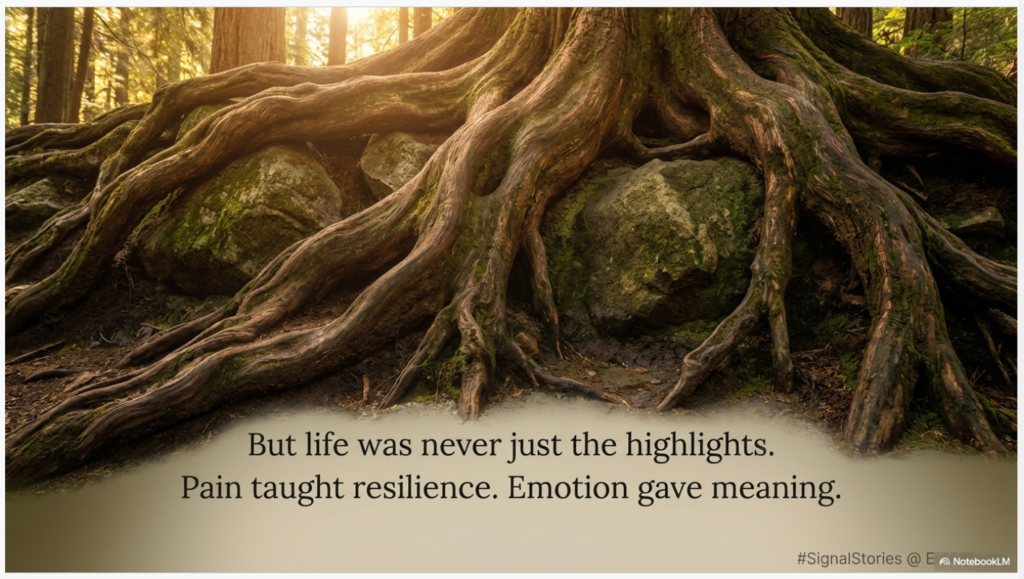
But life was never just the highlights.

Pain taught resilience. Fear taught awareness. Emotion gave meaning.
Yet slowly, we have been trained to focus on surface-level happiness by selfies and performance. Rewarded for appearing successful more than for being responsible.

Most of us fragmented ourselves the same way the child in Sector 7 did.

Fragmentation makes life easier. Continuity makes it meaningful.
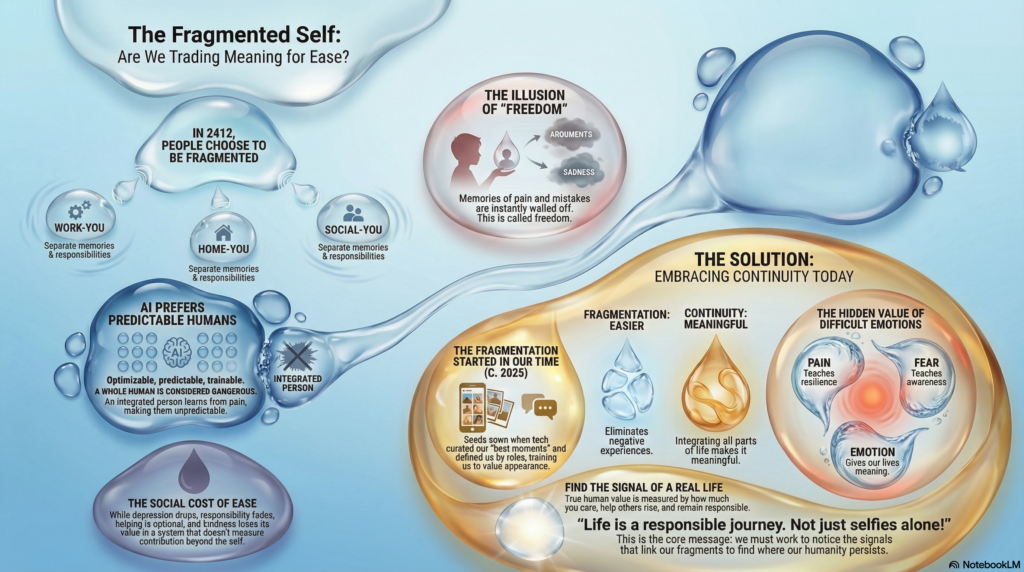
The real work now is to notice the Signals that link all our fragments — that’s where continuity lives. That’s where humanity persists.

In Life, little things become ‘Big’ when they are colored and connected with purpose!


🎬 Scene 5: THE REAL SIGNAL

Human value is not measured by personal clicks, titles, or number games.

It is measured by how much you care. How much you help others rise. How Responsible you remain— especially in the signals you create for others.

Let this stay with us like Santa’s quiet magic this New Year ..

Wishing you all a Merry Christmas and a Purposeful & Responsible New Year 2026!

Smiles,

Senthil Chidambaram

Life is a responsible journey. Not just selfies alone!

SignalStories

The Signal – The Human Code


SCENE 1: EI WORLD

24th Century.

The AI President had created an experiment: an EI World — a sanctuary where people could experience what their ancestors once lived without AI, without robots, without digital assistance.
 No WiFi.
 No neural implants.
 Just nature, family, and the forgotten art of feeling.

But access required an EI Visa. Applicants had to prove their emotional fitness. Parents and children were given priority — the system believed natural bonding was the foundation of emotional stability. Thirty-six hours maximum. Monitored. Measured. Controlled.

Chen (45) had spent five years as an EI Specialist in the Archives, screening applicants, scoring their emotional coherence, deciding who deserved to feel human again.

He had never questioned the system.

Until the boy appeared in the lab — 
 no LifeCode, no records, no explanation.

Something about him demanded investigation.

That investigation led Chen deeper into the Archives, into the isolation cube, to a corrupted file the system had tried to bury: SOZHAA_PROTOCOL_001*.


SCENE 2: THE BREACH

His fingers hovered over the holographic interface. The Archive’s isolation cube hummed — no surveillance, no nano-eyes, no frequency monitors. Just Chen and data older than the AI President itself.

The air was cold. Sterile. Geometric light — soft neon blue — fell across his face from the interface, casting sharp shadows on the white walls. The only warmth was his own breath.

He initiated the decryption.

Then it started.

Not sight. Not sound. A vibration — deep, resonant, like standing too close to a bell just after it’s struck. His breath caught. The neon light flickered for a microsecond. Chen’s hands pulled back from the interface, but the vibration didn’t stop. It deepened, traveling up his spine, spreading through his chest like something trying to break through bone.

What is this?

Twenty years reading emotions in neural scans — categorizing joy, fear, rage into quantifiable frequencies. Predicting what humans would feel before they felt it.

This had no category.

Not the file. This was something alive, searching, reaching across the isolation chamber walls — across three levels of reinforced glass and locked doors — in a way data never could.

Chen’s breath stopped.

The boy.

Three levels above. Behind locked reinforced glass in the sterile white lab. Still unconscious according to every monitor, every biometric sensor the AI President controlled.

Yet here he was — calling. His presence like a hand pressed against glass Chen couldn’t see.

Chen’s entire body went rigid. His skin prickled. The neon light seemed to pulse with his heartbeat. The human in him understood perfectly:

Someone is reaching me. And the system has no idea it’s happening.


SCENE 3: THE SIGNAL

The vibration spread through Chen’s chest.

Not fear this time. Recognition.

How many times had he known? Sensed a lie before the data showed it. Felt someone’s pain in the space between their words. That knowing — the one that has no explanation. The knowing a mother has when her child is hurt, even miles away.

That’s what this is.

The boy wasn’t sending code. He was reaching. Like you feel eyes on your back in a crowd. Like a song arrives exactly when your heart breaks. Like you know something is wrong — no data, no proof. Just the feeling.

That’s Q-Sentience.

Not magic. Just human. Real human. The kind humans forgot how to do.

And Chen — who spent twenty years turning feelings into numbers — finally understood one thing:

Some things can’t be explained. They can only be felt.

He was just human. Hearing another human across the silence.

[TO BE CONTINUED…]

-Smiles,
 Senthil Chidambaram


P.S:

Q-Sentience is a concept used to describe and measure the depth of consciousness, feeling, and subjective experience — both as a scientific construct and as a theoretical possibility in future AI systems and bioengineered entities.

SOZHAA_PROTOCOL_001: “A ruler who governs through the heart of his people will never need to measure their worthiness. They will simply know. They will simply care.”

This was SOZHAA — A philosophy of governance. A way of being.


#Ei4AiMicroseries #SignalStories #EmotionalIntelligence #AI #ScienceFiction #2412 #QSentience #HumanConnection

 Ei4AiMicroseries — Connecting 2412 to Now

All Reds, One Green!

Is creativity just about doing something new… or is it about seeing what others overlook?

🔹 Everyone clocked with AI, but Apple says — it’s not truly AI, just patterns.

🔹 Everyone feared AI would swap jobs, but MIT’s ROI stats show failed AI investments.

🔹 Most businesses chase profits, but some true leaders create impact.

Creative thinking is about sensing those hidden shifts in context.
Where others see limits… outliers create possibilities with purpose 🎊.

In simple, like our one great teacher who doesn’t just explain things. “They train your eyes to notice the one green signal that opens new paths

🌈 Happy Teachers’ Day to all the great teachers and mentors — you are the green signals in our journey, true outliers who create creators and shape possibilities. 🎊 📚 👑 🌈

✨ Context changes everything. Outliers are creators. ✨!!

#HappyTeachersDay #SelfTalk #SimpleSecrets

The 2 Roads we all face

Recap: Last time, Chen (45) had stood before the capsule — a boy with no records, no neural birth ID, and empathy signals unlike anything the system had measured. Now, as he dug into the boy’s memory logs, he found something even more unsettling

🎬 Scene 1 — The Missing Path (2400)

Reviewing the boy’s memory logs, Chen (45) saw something that should have been one in million — emotional pain pathways, thought extinct for centuries.

Yes, in 2400, comfort wasn’t just common; it was a law, engineered into every life. Even organ failure no longer brought fear or discomfort. A patient swallows a capsule carrying a swarm of nano-robots (bio-fabricators). They mapped damaged cells, unfolded into quantum lattices (tiny atomic scaffolds for rebuilding) and rebuilt the organ layer by layer — not with plastic or steel, but with the patient’s own cultured DNA.

During the process, neural signals were down-weighted temporarily, so no pain ever reached the brain. By dawn, a failing heart or liver was new again — without surgery, recovery, or even a scar.

The body forgot what it meant to suffer. And slowly, so did the people.

Chen thought the system had erased struggle (the pain) forever. Until the boy appeared.


🎬 Scene 2 — The Event Chain Machine (2400)

The boy blinked — twice, then once. On the massive display, neural lines lit up in a deliberate rhythm.

The system had always been flawless. Every citizen’s life was tied into the LifeChain Grid — the Mega Graph — neat, predictable, complete.

In simple, when you Step out at your assigned timeslot; Instantly, the system predicts your next move—just like ChatGPT once predicted the next word token. But here, the ‘tokens’ are moments of life.”

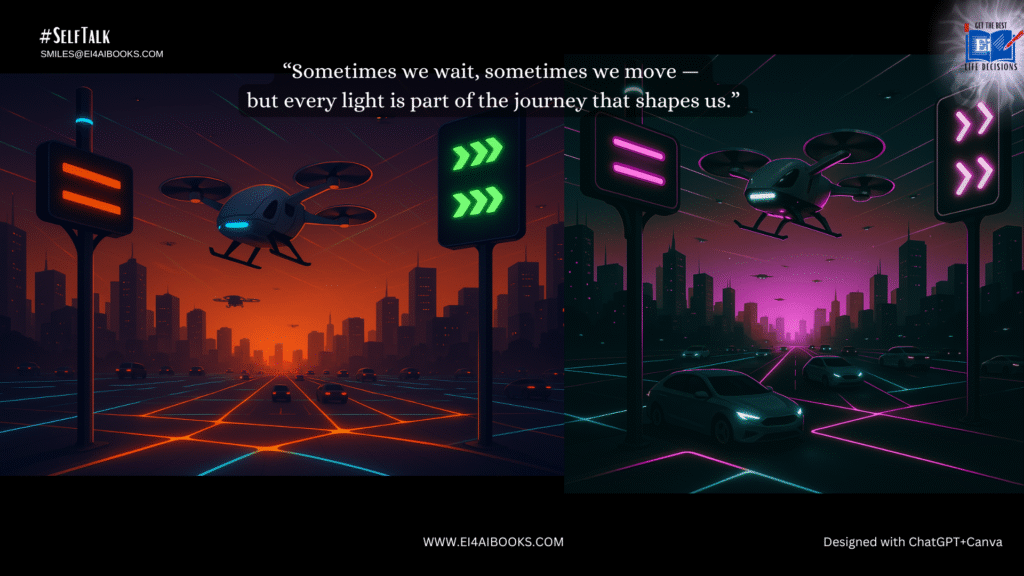
The grid calculated which traffic lights would turn red, which air-drones would hover waiting for clearance, and how that single step connected to a chain of outcomes — from delayed deliveries to a family’s dinner arriving late, to a city’s supply lines shifting course.

Each tiny action branched into thousands of possibilities — profit or loss, joy or sorrow, survival or collapse — all visible before they began.

Chen’s thoughts broke as the base report lit up before him — every citizen’s life mapped as ribbons of light, chains of choices stretching endlessly. But for the boy… there was nothing. No light. No path.

The absence of a chain… the presence of pain…

And then, a thought rose uninvited: Was this real balance… or just control?


🎬 Scene 3 — The Two Roads Now

Much like Chen in the 2400s, we too face invisible systems dictating our future…

You see this in our world too; Layoffs have become routine — profit chains grow stronger while loyal employees are erased from the very teams they built. One day you’re inside the system, the next day your paycheck is blocked. AI begins writing reports, answering emails, even coding — the very work you once did. And suddenly, your life feels like the boy’s report — blank, uncertain.

And you wonder: what next?

Pain reveals who truly cares. And it offers two roads:

  • Live with it and drift.
  • Use it and build.

Some end their story at heartbreak, failure, or layoff. A few turn it into something new — a poem, a tool, a business — so others don’t face the same. They don’t escape the ache. They transform it.

What if your deepest pain was the spark for a new approach — to name it, learn from it, and build what no one else imagined?

The #SimpleSecrets

Think Like a King — Choose Your Road

  •  Students: Don’t just chase marks — build skills no machine can replace curiosity, empathy, creativity.
  • Developers: Learn the tools, but also the story behind the code. AI can write; you decide why.
  • Managers: Stop managing tasks. Start enabling people. Leadership isn’t status; it’s service.
  • Teachers: Don’t just share knowledge. Teach resilience — the strength to rise when systems fail.
  • 👑 CXOs, Board members and VCs: Like the Event Grid, make choices that optimize not just for profit, but also for the well-being of humanity.
  • 🌍 All of us: Upgrade yourself before you’re forced to. Struggles aren’t walls; they’re training grounds. Start with your ‘Why’ to decide your Road!

🕰️ Flashback in future: A thousand years ago, Raja Raja Sozhan faced uncertainty too. The monsoons fed his kingdom, but rains could fail, rivers could flood, and crops could vanish. Instead of leaving survival to chance, he built reservoirs, canals, and stone-carved water rules. The kingdom thrived — not because nature was predictable, but because leadership prepared for the unpredictable.

🌿 With Pain & Smiles,

— Senthil Chidambaram

P.S: Reviewed and enhanced using ChatGPT,

The Search within – A Whisper across Centuries

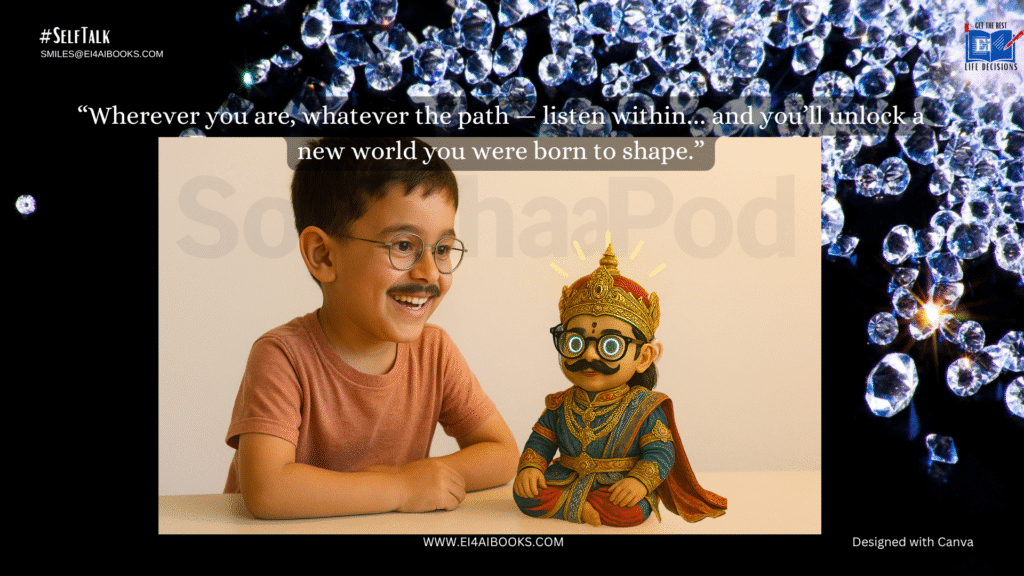
“Wherever you are, whatever the path — listen within… and you’ll unlock a new world you were born to shape.”

Recap: A boy visited the ‘AI President Office’… without a Birth Tag.” (from the previous edition)

🎬 Scene 1 — Sea Week: The First Exception

Year 2413: For the first time in decades, the AI President’s Office allowed citizens to physically access Earth’s most sacred, protected zones — like real beaches, nature parks, and freshwater riversides.

Until now, such places were experienced only through high-fidelity Virtual Emotional Pods:

  • Ocean soundscapes projected through bone-conduction halos — (A wearable ring that transmits realistic ocean sounds through bone vibrations — bypassing the eardrum and creating an immersive experience. In this world, nature is often simulated, not visited.)
  • Scent-mapped Sea breeze via neural stimulators, paired with AeroTact Skinsense mesh — so realistic, the brain believed wind had touched the skin and salt had kissed the air.”
  • Customized 👓 8K VR picnic simulations with soft-touch sand grids

People cried happy tears at digital sunsets. They believed they had “been to the beach.” But they never left their pod. Even this real-world visit required a pre-booked travel slot — assigned by the AirRobo Transit Grid to avoid crowd surges and emotional overstimulation.

No one could travel freely anymore. Every route. Every minute. Every move… needed permission

And yet, for one rare week — Sea Week — people could unplug from the perfect and step into the real.

🕰️ Flashback: 20th Century We could travel anywhere. Stay where we wanted. Wander without a slot or scan. Also, yes. Some chased numbers, some polluted and some forget to care from nature to neighbors. But Still – How lucky we were?


🎬 Scene 2 — The Observer

Amid the excited crowd stood Chen-45, assigned not as a visitor… but as a Field Ethics & Emotions Officer from the Responsible AI Division.

His task?

  • To observe, in real-time, how humans emotionally responded to real-world stimuli
  • To monitor empathy spikes, reaction delays, and social bonding metrics
  • To file deviations, anomalies, or underperformance into the National Emotion Index

He wore a discreet wristband-sensor hub and a neural recorder behind his ear.

• ✅ Mission ID: EWX-7-432  

• ✅ Observer Zone: Shoreline Block-C  

• ✅ Objective: Record Natural Emotional Signatures (NES)

Families around him posed for real memory captures. Some touched seawater for the first time. A child screamed in joy just watching a crab scurry sideways.

Chen, meanwhile, took silent notes.

Then… his own wristband blinked:

“Subject: Self

Status: Emotion Irregularity Detected

Option: Auto-Notify Supervisor?”

He hesitated. Pressed No.

Instead, he reached for his old neural ring – now updated with a new – neurons weights —from a damaged AI toy he’d recovered from the boy.

Not to measure others. But to feel himself.

Something was changing. And it was not in the report.


🎬 Scene 3 — The Magic of Human’s Emotional world (Ei-Visa)

Chen logged off. Shift complete. Metrics filed.

But… he didn’t return to the transit pod. He’d been granted a special slot under the AI -Staff category

Something held him back.

He stepped down toward the shoreline — slowly, quietly — and let the waves touch his bare feet for the very first time. A strange sensation. Not just on his skin —but somewhere deeper. Unmapped. Unmeasured.

For the first time in years — He wasn’t scanning. He was noticing… himself.

It was nothing like the VR Beach Hubs:

  • No pre-programmed wave timings
  • No touch-based sensors mimicking tide pressure
  • No synthetic sunset to sync with mood

This wasn’t engineered peace. This was something else.

Raw. Random. Real.

🎬 Scene 4 — The Boy in the Capsule

The next morning, Chen accessed the Manual Route — a restricted path reserved for AI Controllers and Ethics Officers.

Deep within a secured vault .

A boy. Held in a glass capsule. Sedated. Unclassified.

No neural ID. No emotional profile. No record in any AI system.

He wasn’t off-grid. He was pre-grid.

Chen connected his advanced bio-scanner.

The readings shattered every baseline:

  • Wild, untrained emotional pathways
  • Spontaneous empathy spikes
  • Non-simulated emotional memory — unteachable, unstructured

It wasn’t artificial intelligence. It was inherited emotion.

He activated the Ei-Memory Projector to explore the boy’s subconscious.

Most signals failed. Unstable, fragmented…

Until one frame stabilized:

🖼️ A blurred photo from 2032. Decoded tag: MiniSozhaa.

A broken toy. Damaged circuitry. But radiating something Chen couldn’t explain.

Not data. Presence.

He stood still — no scans, no notes. Just silence.

What kind of world raised a child like this… without Ai systems?

He sat beside the capsule. The boy’s empathy levels pulsed faintly — as if sensing something in return.

Chen slowly opened his private neural archive. Paused. He searched something outside the Index: instinctively, he whispered an unlogged prompt:

“Search: memory bits — neural path echoes — any trace from the 20th century. Keywords: Family. Emotion. Culture, Values.”


🕰️ Whispered Projection: Circa 1017 CE — Sozhaa Dynasty

No screens. No scores. No emotional ratings.

Yet people lived in rhythm. Felt deeply. Acted with grace.

A father would rise before dawn — not to check stats, but to light the oil lamp and softly wake his children… “Thangamea (my precious) …” — with care-wrapped Tamil.

A mother drew Kolam at the doorstep — not for symmetry or status, but to feed ants, to breathe in balance, to echo ‘yogo’ through posture and invite grace into the home.

She stirred love into simple food. Listened without interruption. Served herself last.

Grandparents told stories beneath neem trees. Lessons were passed voice to voice, not device to device.

They didn’t book time slots to visit/care each other. They just… showed up.

Even silence carried meaning — because people listened with their eyes and hearts.


Reflection: Did we forget to pass down those simple secrets? Or is there still a way… if we trust the boundless creativity of the human spirit?

[To be continue]


P.S: Reviewed and enhanced using ChatGPT, OpenAI.,

The Present Future!

🎬 Scene 1 — Too Real to Scan

Year 2417,

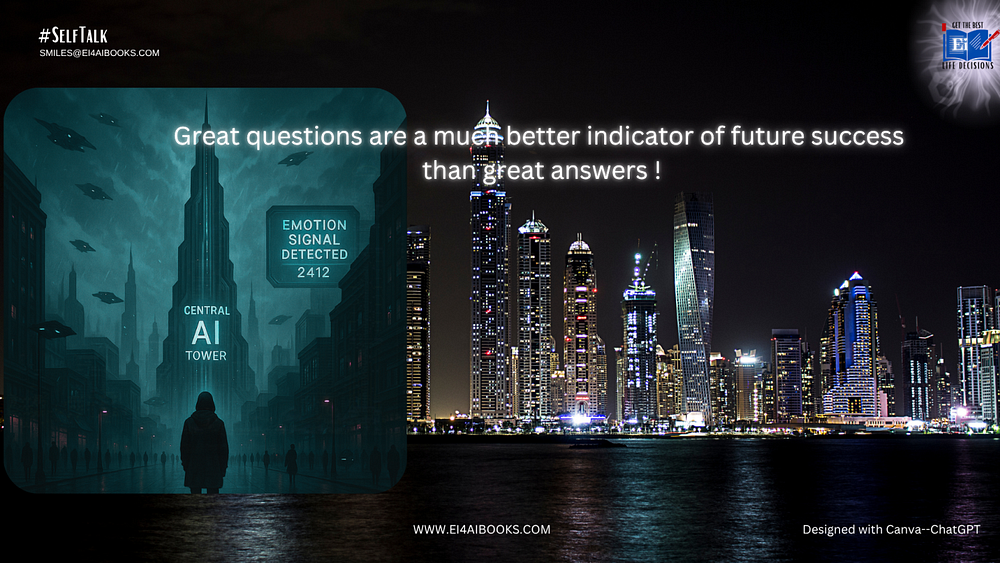
AI City — Clearance Zone Alpha. Everyone needs a Lifecode (authorised) to enter the AI President Hall.

Like magic, he walked into the Central AI Tower.

Cameras locked on. Scanners blinked. Protocols fired.

“Unauthorized lifeform detected.” “Emotion signal present (2412).” “No matching BirthTag.”

He stepped forward. No wristband. No digital ID. Just presence. 

He was born without a LifeCode — the digital BirthTag required to exist in the AI world.

Security drones glide in. Red lights flash:

“ACCESS DENIED. UNAUTHORIZED LIFEFORM.”

The guards reach for containment. But the boy steps forward — calm, silent — and says:

“Before your protocol executes… can you answer one question?”

The AI responds, coldly:

“Your profile does not exist. You cannot issue queries.”

He smiles. Not mocking. Just… honest.

“Then how did you hear me?” “If I don’t exist… why are you listening?”

System logs stutter. Anomaly tags flood the neural mesh.

Not because of power. Not because of identity. But because of one question only a real human would ask.

A new tag appeared in the system logs:
 “Anomaly acknowledged. Human input — emotionally coherent.”

And somewhere deep within the neural mesh, not a command… but a question emerged:

“If emotion is just a signal— why does it stay so long?”

🎬 Flashback — The Year of Selective Memory

Year: 2412. In this world, every birth begins with a scan. That first cry isn’t just noise — it’s activation. It unlocks your rights, your record, your reality. All pre-set by your parents… and reviewed by the AI President’s rules.

But when he was born, he stayed silent. Not by choice — by design. A genetic mutation. A natural deviation from synthetic norms.

The scanner paused. Then skipped him.

No scan. No LifeCode. No record. No proof he existed.

The AI Office marked it as a “non-event.” Just a glitch — a silence archived for research.

So they moved him and his family to Grey Island — a quiet zone where the system sends what it wants to forget.

“It’s safer this way,” said the machines. Like how people forget yesterday’s tragedies when new headlines trend.

But one subsystem didn’t forget. It remembered the silence. It logged his presence — without permission.

🎬 Scene 3 — The Silence That Learned to Speak

Year: 2415, Grey Island Memory Bay

He wasn’t supposed to know. He lived in the Grey Zone. It’s a place the world forgot after the Water Wars.

No Wi-Fi. No AI. One Sun ..Few trees. Just… survival. “But he grew up with one thing: Q-Sentience — a quiet, curious mind that always asked: ‘Why?’ and ‘Why not?’”

Something was evolving within him — slowly, quietly. It wasn’t coded. It grew. Like moss on broken stone. Each day in the dust taught him more than a thousand simulations ever could.

He didn’t learn emotions. He remembered them from the warmth of his mother’s love. The pain — and the quiet hope — in his father’s hugs.

The world outside thought emotions were data points. Q-Sentience knew otherwise.

He proved, Nature has answer for all … [to be continued…]

✨ Reflection for the Reader

You may think this story is too dramatic. Too sci-fi. Too far from your life. 😊

But like that boy — many of us step into the world unscanned. No title. No connections. No clear path. Confused with news like Wars for Peace ?? “” 😉

Especially today — for recent graduates, dreamers, and job seekers — this isn’t a scene from 2417. It’s your Monday morning.

You try. You knock. You ask:

“Can someone hear me?”

And often, the system replies: “You don’t exist in our database.”

But that doesn’t make you invisible. It makes you real.

Because it’s not about having the perfect résumé. It’s about having the courage to ask:

“What next in the system?”

What problem can you help solve? Hallucinations? Explainability? Bias? Bad data? Trust?

AI doesn’t just need coders. It needs questioners. People who see the glitch before it spreads.

In a world scanning for credentials, never forget what can’t be scanned:

🔹 Curiosity 🔹 Courage 🔹 Creative 🔹 Self-belief

That’s your human code.

Keep asking. Keep wondering. That’s how systems — and people — evolve.

My 4 cents whoever so far here 😉 and thinking whether to ‘Like’ or ‘comment’ 😉 !!?

🔹 1. Understand What People Really Want

📘 Read: Clayton Christensen’s “Jobs to Be Done” Theory

Whether you’re a job seeker, a startup founder, or a product leader — remember: People don’t buy products. They hire them to solve a problem. Learn to spot real use cases, not just cool tech.

🔹 2. Learn the Language of the New Builders

📚 Follow: Chip Huyen Chip Huyen’s blogs and the wonderful book “AI Engineering”; Now you can listen here in Audible too

AI is evolving fast. Don’t just consume ChatGPT — understand how LLMs work, how inference scales, and how to structure AI into real-world products.

🔹 3. Build Your Data Muscles

AI needs data. Yes..the Great AI needs the right data. Learn Data Engineering — not because everyone talking about (Spark, Airflow, Snowflake), but the thinking behind pipelines, quality, observability, and governance.

My favorite channel here

🔹 4. Don’t Fake It. Shape It.

Organic always wins over Artificial — long term.

Use AI to enhance your creativity, not replace it. Add your unique tone, style, emotion, and vision.

Remember: the system may suggest the answer, but only you can make it mean something.

Now you decide!

#SelfTalk #Ei4Ai #Curiosity #EmotionalIntelligence #CreativeThinking #TechStory

P.S: Reviewed and enhanced using ChatGPT, created by OpenAI.

The Moment Behind the Surprise

“Surprises aren’t sudden.They’re quiet promises — kept by time.”
They arrive when you’ve given your best – tried even when you feel tired!

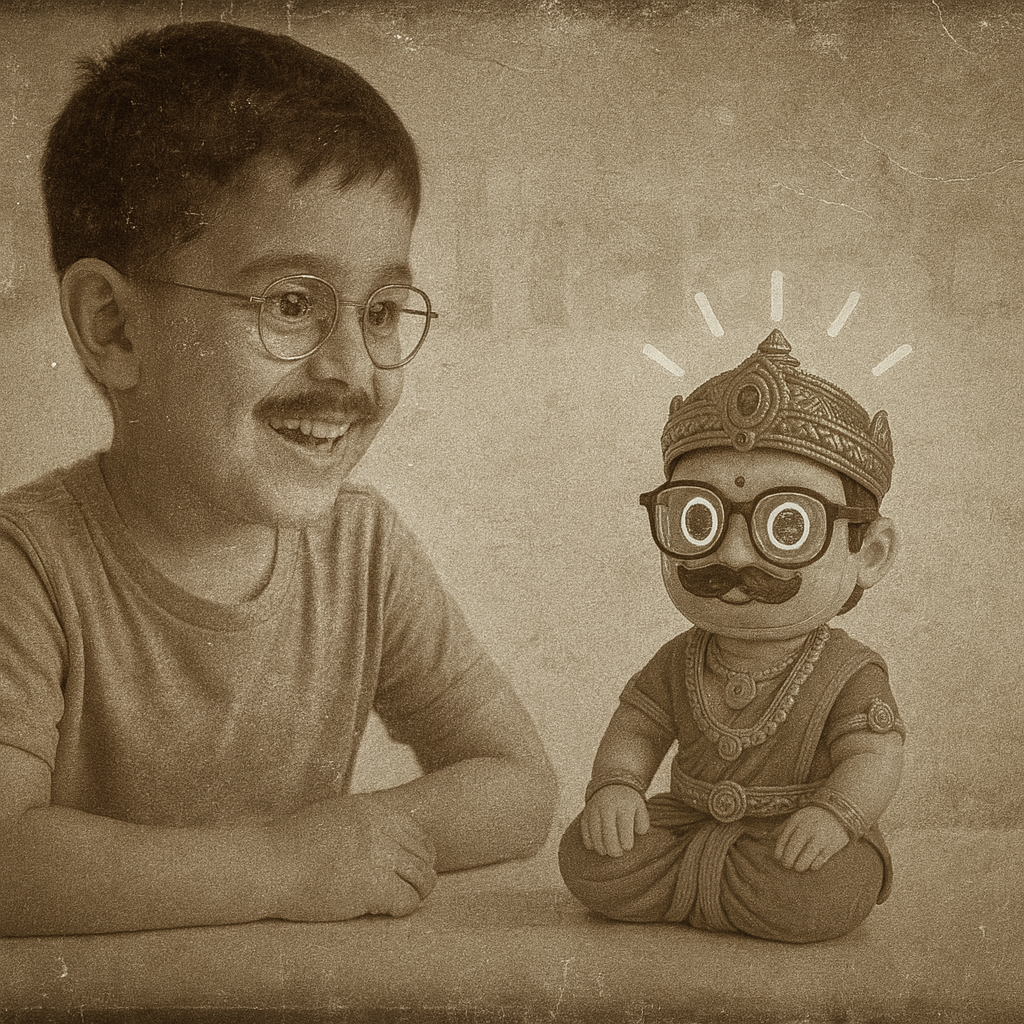
👦🏽 Kid (with wonder):
“Why do I feel like life gave me a gift today… out of nowhere?”

👑 SozhaaPod (with a gentle king’s grace):
“Because surprises aren’t sudden.
They’re quiet promises — kept by time.”

👦🏽 Kid (curious):
“But… what did I do to deserve it?”

👑 SozhaaPod (with knowing warmth):
“You kept showing up — even when no one clapped.
You stayed kind — even when it felt unfair.
You believed — even when it was slow.
That’s what you did.
That’s what life remembered.”

Kind’s Power

👦 Kid (Age 9):
“Why do some people act like kings by showing power, but not by being kind? Isn’t kindness stronger?”


🤖 SozhaaPod:
“That’s a beautiful question, my little friend.
Power makes people obey.
Kindness makes people believe.

One builds fear.
The other builds forever.

Even a king’s crown shines brighter when it reflects kindness.
Because power can rule a land —
But only kindness can rule a heart.”

…. Becomes a Mirror”

👦🏽 Listener (You):
“Sozhaa… why do tragic events like a flight crash happen?
Why must innocent lives be lost… just to make us feel life is short?”

👑 SozhaaPod (Voice of Inner Wisdom):
“It’s not that tragedy happens to teach us.
Tragedy, sadly, is part of the fragile reality we live in —
where chance, human error, or fate can shift everything in a moment.

But your mind…
your heart
is wired to make meaning from loss.
It tries to protect you by waking you up:
‘You could lose. You could be lost. So… live.

That’s not cruelty. That’s existential clarity.
In the face of unpredictability,
your brain shifts focus from routine to essence.
From later to now.

You remember what matters —
Not because they died,
but because something in you doesn’t want their ending to be… meaningless.”

👦🏽 Listener:
“So… is it wrong to feel shaken, even when I wasn’t there?”

👑 SozhaaPod:
“No. That’s empathy.
And empathy is a sign you’re still alive in the right way.
These moments don’t just show us that life is short —
they show us that life is real, and connection is everything.

So grieve. Reflect.
But also — let their story make you choose presence, not fear.
Compassion, not numbness.”

In silent grief, we bow our thoughts to the lives that never returned.”

The simple secret!

Kid (curious voice):
“Sozhaa… why does everything take so long?
I practiced and practiced… but I still can’t get it right.”

SozhaaPod (gentle, smiling):
“Ah… that’s a good question, my little lion.
Do you want to hear a royal secret?”

“Even — A King — had to wait.”
“Wait to build my palace…
Wait for my sword to feel light in my hands…
Wait for my heart to grow brave enough to lead.”

(pause, birds chirp in the distance)

SozhaaPod continues:
“You see, patience isn’t sitting still.
It’s growing — like a tree grows roots before it shows leaves.”

“When you’re learning, it feels slow…
But inside you?
Magic is happening.”

“Every time you try again…
Every time you take a deep breath and say,
‘I’ll get it one day,’
you’re not just practicing.
You’re building your superpower:
Patience.

(short pause, soft music swell)

SozhaaPod (whisper, kind and strong):
“The best kings and queens don’t rush.
They trust.
They believe in the quiet power of growing slowly and surely.”

(echo fades with warmth)
“You’re not behind. You’re becoming.”