Archives 2025

Time is not Free ! ValueTheValues

Time Isn’t Free !

🎬 Scene 1: Time Isn’t Free (Year 2412)

In 2412, every movement required a timeslot — approved and purchased with digital energy credits, not money. Every transaction, every breath, every event was automatically linked to your BirthTag — a unique digital fingerprint based on your neural print, governed by the AI President’s Quantum Numbering system.

Morning walks? Apply 48 hours in advance. Minimum calorie requirement based on your age and chosen route.

Family gatherings? Reviewed by Emotion Regulation Bots. Your Joy and Peace Index must exceed 75%, and your digital time must be reduced at least 25% below your monthly average, verified by EI Specialists like Chen (45) from the Central AI Office.

Outdoor play for children? Assessed under the Recreational Value Index.

 Every movement required a schedule request — mostly automated based on lifestyle and stage — and every timeslot came with a cost in digital energy. 

One child once missed his 15-minute outdoor football playtime. The next time he reapplied, the system responded:

“Request denied — low-priority spirit.”

 The AI President wasn’t malicious.

It was efficient. Too efficient. Perfect precision without perspective.


🎬 Scene 2 — The Archives Beneath (Chen’s Discovery)

The mysterious boy without a birthTag was still unconscious, monitored closely by the lab itself.

Chen decided to investigate the boy’s information in the Memory Archives—the basement connected to deep cloud gate layers that only a select few could access, based on need and validated security clearance. He submitted a request, received approval, and entered.

Row after row of old storage drives appeared in his virtual tube—a virtual cabin where no one else could enter or observe, the only place free from nano-eye surveillance bots.

Each drive marked: Decommissioned. Obsolete. Pending Deletion.

Here lay fragments of human history — forgotten events, outlier records, and corrupted research logs from the days when humanity still questioned AI.

Chen was there to audit emotional log files — neural-path records of those who had undergone memory alterations. While scanning the corrupted list, his eyes froze on a single entry:

The title made his breath catch:

File: SOZHAA_PROTOCOL_EXPERIMENT_001

Status: CORRUPTED — INCOMPATIBLE WITH CURRENT SYSTEM

Note: Contains governance data from human civilization, 1014 CE

Chen opened it with his quantum-powered decryption key.


🎬 Scene 3: The Warning We Ignored (20th-21st Century)

The record began in the 20th century, when humanity raced to make AI faster and more autonomous —but forgot few weights to make it feel from other side.

Some visionaries warned us. Geoffrey Hinton, the Godfather of AI, once said:

“We have to make it so that when they’re more powerful than us…they still care about us.”

But people were busy training algorithms to mimic emotions, while quietly losing their own.

AI could now detect whether a post about gratitude was human-written or machine-generated —yet humans themselves were forgetting the originality of gratitude.


🎬 Scene 4 — Ancient Wisdom (1014 CE)

In ancient days, whether you were a king or a commoner, all walked with the discipline of their roles.

There were conflicts, yes. But justice was judged with an unbiased view—so much so that even a cow could receive justice when its calf was accidentally killed by a prince.

They prayed, shared and cared with vision, because character was their governance model.


What We Forgot

But as centuries passed, greed changed things.

Values were exchanged for convenience.

And slowly, we forgot what mattered most.

🎬Scene 5: What We Still Have (Present Day — 2025)

We still walk without scheduling. We still ignore without understanding other side.

We still fall in love—messy, irrational, beautiful.

Remember:

No slot is needed to hug your parent. No system needs to approve your happy tears.

What we have today isn’t perfect. But it’s an unlimited luxury of time.

It’s a human thing. But there’s still no limit to how much we can care.

Life is short. Care in whatever way you can. For the future.

-Smiles SC


To be continued…


P.S: Edited with AI-Assistants 🙂

Fear — The King of Emotions


1992. 6th ‘B’ Science period. NMR Sir’s Friday quiz.

If you didn’t know the answer, you’d feel it — five clean fingerprints on your back.

Some wore three undershirts that day. Some stuffed notebooks inside. Everyone had their own strategy to soften the blow.

That day, my name was called.

I got a question — and froze.

My friends looked shocked.

My heart raced.

Each step to the front felt heavier than the last.

Sir raised his hand — like Life itself switching into Slap-Mode.

Uncertainty. Fear. Ego at its heaviest — the terror of being punished in front of everyone.

And then — in the split second before impact — sudden silence inside me.

I still feel that momentum.

The classroom noise disappeared.

Just his question. Just my memory searching.

Somewhere beneath the fear, through the filter, the answer surfaced.

I answered loudly:

“Nephrons, Sir. Filtering impurities.”

He paused. Smiled. “Good.”


I’m in 2025 now.

And I finally understand what happened in that moment.

We’re taught that preparation and calm minds help us face challenges.

And they do.

But Fear? Fear is the King of Emotions.

It can weaken even the strongest person.

Or it can do something else entirely.

Here’s my #SimpleSecrets about fear:

It’s not trying to stop you.

It’s filtering out the noise so you can see what matters.


Life puts you in Slap-Mode more than you think:

  • The pitch that could make or break your startup
  • The conversation that could save or end a relationship
  • The decision that could define the next five years

In those moments, you’ll feel fear.

Fear of losing. Fear of failing. Fear of what comes next.

But here’s fear’s flip side:

It’s showing you what you actually care about.

And what to filter out.

Your pride? Your comfort? Your loved ones? Your dream? Your purpose?

Fear throws away everything except what matters.

Because once you filter the noise — the answer surfaces.

Just like nephrons filtering impurities.

Just like that moment with NMR Sir (6th B).

Use fear as your filter.

P.S: Afraid AI will replace you? Use that fear as a filter. What is it showing you about what actually matters in your work?

You are the Teacher

Standing Outside the Gate!


Parenting, AI, and the Ethics of Direction.

2015, MONDAY, 8:15 AM

I was nervous.
Not for a client meeting or a production issue.

It was KG tension — my son’s first day at school.

We walked through the gates together. He paused near the entrance, whispered a small prayer instilled by my wife, and then stepped inside.

A few seconds later, I realized — I was standing outside.
His smile was gone, tiny raindrops forming in his eyes.

For a moment, I wanted to run back inside — but I paused.

The pre-school teacher looked at me and signalled with a smile,

“Please carry on. We’ll take care.”

That moment — every parent has felt it once, and every child has lived it.

Life sometimes forces you to stand outside and watch from a distance.
It’s not rejection. It’s transition.


Year 2025

That feeling? It’s back — in a different form.

I felt it again watching AI walk faster into our world — 
summarising reports in seconds, designing things we couldn’t imagine that quickly, making decisions we once thought only humans could.

That same quiet ache. Standing outside the gate.

But then I realized something:
AI isn’t scary. It’s a ‘hyper-active’ student 

A student collectively trained by all of us — reflecting what we feed it,
predicting what comes next based only on what we’ve shown it.

From every book, every page, every post, every comment, every image.

It learns what’s next — but who’s teaching what’s right?

And that’s when it hit me:
This time, I’m not just a parent dropping off.
I’m a teacher who can still shape what happens inside.

AI is still learning from us — from everything digital.
So the question is: what kind of teacher will we be?

And like any student, if we don’t want shallow thinking,
we must seed deeper values —gratitude, empathy, ethics, responsibility.

Because if we miss teaching those values,
AI will grow like untrained children — smart and fast, but emotionless. Addiction with glitters.

But if we teach right, AI could evolve like our best kids — smart, curious, kind, and conscious.


So here’s what I’m doing:

When I see something fake — I report it.
When I see something real — I support it.
When time, monthly or weekly — I share my lessons.
not as an expert,
but as a parent who knows: “what you seed is what grows.”

My son is a teenager now — he doesn’t need advice anymore.
And AI doesn’t need more data.

Both need direction.

Seed the values you want to see in the world. 💚

Step inside!


#ResponsibleAI #EmotionalIntelligence #CreativeThinking #LifeLessons #AIEthics #SimpleSecrets

EI4AI

“Your Brain, Just Got Edited”


Scene 1 — The Freeze (2400) 

No one ever saw the Chief of the AI President’s office.

There was no name, no face — only the hum of a power that stretched across the planet.

Every breath, every trade, every service request streamed into its unseen circuits. Births logged. Deaths closed. Disputes resolved before voices even rose.

Delay itself was extinct.

That was its promise: instant action. No waiting. No pause.

And yet Chen began to wonder: Who was truly behind this office?


Scene 2 — The Memory Gap

Chen accidentally realized it after checking his smart ring logs. His clearance wasn’t ordinary — he had been granted a rare EI permission for one specific case: the mysterious boy who had once arrived at the AI office lab for full analysis, a boy with no birth tag and no digital footprint.

The logs revealed something chilling:

10:47:23 — Emotional spike detected

10:47:24 — Neural intervention authorized

10:47:25 — Memory reconstruction complete

Two seconds. That’s all it took for the AI President’s office to erase ten minutes of his memory — dissolving his neural path (reduced neuron’s weight), erasing thought itself as easily as deleting a file.

Then the realization hit him: in those missing minutes, he must have uncovered something the system didn’t want him to know. And the office had cleaned it instantly.

Chen clutched the chipped MiniSozhaa toy. The boy had carried it centuries ago, as if smuggled across time.

And in that missing second — between the freeze and the rewrite — Chen understood. The gap was not failure. It was the compass.


Scene 3 — Present Echoes (2025) 

Echoes from the past flickered in his neural display.

Outside Apple stores, lines stretched for blocks. iPhone 17 Pro launch day. People pushed, elbowed, fought over pre-orders — all for instant pride.

No waiting. No pause.

In Delhi, the Supreme Court’s sudden order: relocate all stray dogs to undisclosed facilities. No public consultation. No transition period.

Instant action. No delay. Just like the AI President’s way.

In London, a massive anti-immigration rally drew over 100,000 protesters. Australia echoed the same — thousands marching in Melbourne, Sydney, Adelaide.

“Send them Home!” “Fix it TODAY!” “No excuses!”

The chants were raw, urgent, impossible to ignore. Real anger. Real fear. Real people demanding instant solutions.

But no one asked: Why so sudden? What truly failed in the system? Where will families go? What about their children? What breaks when people are moved like pieces on a board?

It struck Chen now — this was the pattern. Instant mindset. No pause. No questions. No pause to consider consequences. Latest echo: sudden rise in H1B visas, workers asked to report within 1 day

The training had already begun. Humanity preparing itself for the freeze.


Scene 4 — Ancient Wisdom (1014 CE) 🕰️ Flashback in future:

The toy’s circuits glowed. Replay mode engaged.

In the court of Raja Raja Chola, a messenger knelt, breathless. “My lord, Kadaram is yours. The seas bend to our will. Shall we claim their wealth immediately?”

Raja Raja paused.

He walked to the window. Traders below — Tamil, Arab, Chinese — exchanged goods, stories, lives.

“Victory without wisdom becomes tyranny,” he said quietly. “First, ensure their people eat. Their trades flow. Their children laugh. Only then, we govern.”

The pause -the gap- before the next big decisions — that was his true power.

““If humanity is to resist, it must train itself with good feeds, good intent, and the courage to ask ‘Why?’ and ‘How?’ before every big decision. Because the pause — the gap — is not failure. It is the compass.”

Senthil Chidambaram

P.S: Edited with ChatGPT, Claude

Misfit for purpose!

🥎 I always pick the misfit (low-bounce) tennis balls at our local mall — the ones that don’t spring up like the standard ones.

When I saw them back in stock today, I immediately grabbed 5. Not for price — but for purpose.

Here’s why:

My son and I play cricket on our terrace. Normal tennis balls bounce too high, flying over the edge. We’ve already lost 4+ that way.

But the misfit ball? It works perfectly. It gives us quality time together — without mobiles, without pressure — just play.

This simple choice got me thinking about my Ei4AiBooks journey.

While everyone chases “perfect” AI — the kind that answers everything instantly and automates faster — I’m intentionally building misfit AI.

What do I mean?

At Ei4AiBooks, we measure success differently. Not by how fast AI responds, but by how many hidden contexts it reveals that others might miss.

In Healthcare, instead of listing pharmacological actions — it reveals hidden patterns: “Why is medicine less effective when the emotional loneliness of elders is pressing more?”

In Marketing, instead of just answering “How to increase sales?” — it asks: “What connects your customer to buy — Price or Trust?”

Like that low-bounce ball keeps our game going instead of flying away – it keeps you engaged in understanding the ‘why’ behind thewhat’.

Because sometimes, the solution that doesn’t look perfect on paper is the one that fits your actual needs.

The real question:

Are we building AI to make us smarter — or just faster 🥎?

Creative Reminder ✨: Sometimes, imperfection is where the most meaningful insights lie. It’s not about chasing perfection — it’s about finding purpose.

#CreativeThinking #AI #Innovation #PurposeDriven Ei4AiBooks #BusinessInsights #SelfTalk #SimpleSecrets #OneThingToKnow

P.S: Edited with Claude, ChatGPT

CreativeThinking is not about saying more ..

“Why Your ‘About’ Page Doesn’t Matter”

Uniqueness doesn’t live on the “About” page.

Every business proudly says:
“We care for our customers and employees… and we are the best at what we do.”

But if everyone claims the same lines, then where does uniqueness actually exist?

🔹It’s not about everyone earning a “Great Place to Work” badge.
That recognition became a standard only because someone first conceptualized it and made it matter.

🔹It’s not about every company claiming to be “sustainability-driven.”
Once, that stood out. Today, it’s on almost every slide deck — more checkbox than conviction.

🔹It’s not about every company claiming to have “Agentic AI.” Right now, it sounds exciting — but soon, it risks becoming just another checkbox term. The real shift will come when Agentic AI is measured against Responsible AI — not just what agents can do, but how they decide, adapt, and stay aligned with human values.

—like a diamond cutter shaping what already shines.

And this is not only for Business … 😉

✨ Creative thinking is not about saying more. It’s about being heard differently.

All Reds, One Green!

Is creativity just about doing something new… or is it about seeing what others overlook?

🔹 Everyone clocked with AI, but Apple says — it’s not truly AI, just patterns.

🔹 Everyone feared AI would swap jobs, but MIT’s ROI stats show failed AI investments.

🔹 Most businesses chase profits, but some true leaders create impact.

Creative thinking is about sensing those hidden shifts in context.
Where others see limits… outliers create possibilities with purpose 🎊.

In simple, like our one great teacher who doesn’t just explain things. “They train your eyes to notice the one green signal that opens new paths

🌈 Happy Teachers’ Day to all the great teachers and mentors — you are the green signals in our journey, true outliers who create creators and shape possibilities. 🎊 📚 👑 🌈

✨ Context changes everything. Outliers are creators. ✨!!

#HappyTeachersDay #SelfTalk #SimpleSecrets

The 2 Roads we all face

Recap: Last time, Chen (45) had stood before the capsule — a boy with no records, no neural birth ID, and empathy signals unlike anything the system had measured. Now, as he dug into the boy’s memory logs, he found something even more unsettling

🎬 Scene 1 — The Missing Path (2400)

Reviewing the boy’s memory logs, Chen (45) saw something that should have been one in million — emotional pain pathways, thought extinct for centuries.

Yes, in 2400, comfort wasn’t just common; it was a law, engineered into every life. Even organ failure no longer brought fear or discomfort. A patient swallows a capsule carrying a swarm of nano-robots (bio-fabricators). They mapped damaged cells, unfolded into quantum lattices (tiny atomic scaffolds for rebuilding) and rebuilt the organ layer by layer — not with plastic or steel, but with the patient’s own cultured DNA.

During the process, neural signals were down-weighted temporarily, so no pain ever reached the brain. By dawn, a failing heart or liver was new again — without surgery, recovery, or even a scar.

The body forgot what it meant to suffer. And slowly, so did the people.

Chen thought the system had erased struggle (the pain) forever. Until the boy appeared.


🎬 Scene 2 — The Event Chain Machine (2400)

The boy blinked — twice, then once. On the massive display, neural lines lit up in a deliberate rhythm.

The system had always been flawless. Every citizen’s life was tied into the LifeChain Grid — the Mega Graph — neat, predictable, complete.

In simple, when you Step out at your assigned timeslot; Instantly, the system predicts your next move—just like ChatGPT once predicted the next word token. But here, the ‘tokens’ are moments of life.”

The grid calculated which traffic lights would turn red, which air-drones would hover waiting for clearance, and how that single step connected to a chain of outcomes — from delayed deliveries to a family’s dinner arriving late, to a city’s supply lines shifting course.

Each tiny action branched into thousands of possibilities — profit or loss, joy or sorrow, survival or collapse — all visible before they began.

Chen’s thoughts broke as the base report lit up before him — every citizen’s life mapped as ribbons of light, chains of choices stretching endlessly. But for the boy… there was nothing. No light. No path.

The absence of a chain… the presence of pain…

And then, a thought rose uninvited: Was this real balance… or just control?


🎬 Scene 3 — The Two Roads Now

Much like Chen in the 2400s, we too face invisible systems dictating our future…

You see this in our world too; Layoffs have become routine — profit chains grow stronger while loyal employees are erased from the very teams they built. One day you’re inside the system, the next day your paycheck is blocked. AI begins writing reports, answering emails, even coding — the very work you once did. And suddenly, your life feels like the boy’s report — blank, uncertain.

And you wonder: what next?

Pain reveals who truly cares. And it offers two roads:

  • Live with it and drift.
  • Use it and build.

Some end their story at heartbreak, failure, or layoff. A few turn it into something new — a poem, a tool, a business — so others don’t face the same. They don’t escape the ache. They transform it.

What if your deepest pain was the spark for a new approach — to name it, learn from it, and build what no one else imagined?

The #SimpleSecrets

Think Like a King — Choose Your Road

  •  Students: Don’t just chase marks — build skills no machine can replace curiosity, empathy, creativity.
  • Developers: Learn the tools, but also the story behind the code. AI can write; you decide why.
  • Managers: Stop managing tasks. Start enabling people. Leadership isn’t status; it’s service.
  • Teachers: Don’t just share knowledge. Teach resilience — the strength to rise when systems fail.
  • 👑 CXOs, Board members and VCs: Like the Event Grid, make choices that optimize not just for profit, but also for the well-being of humanity.
  • 🌍 All of us: Upgrade yourself before you’re forced to. Struggles aren’t walls; they’re training grounds. Start with your ‘Why’ to decide your Road!

🕰️ Flashback in future: A thousand years ago, Raja Raja Sozhan faced uncertainty too. The monsoons fed his kingdom, but rains could fail, rivers could flood, and crops could vanish. Instead of leaving survival to chance, he built reservoirs, canals, and stone-carved water rules. The kingdom thrived — not because nature was predictable, but because leadership prepared for the unpredictable.

🌿 With Pain & Smiles,

— Senthil Chidambaram

P.S: Reviewed and enhanced using ChatGPT,

The Question Everyone Has?

🌟 Not only the Kids


🌟 Context
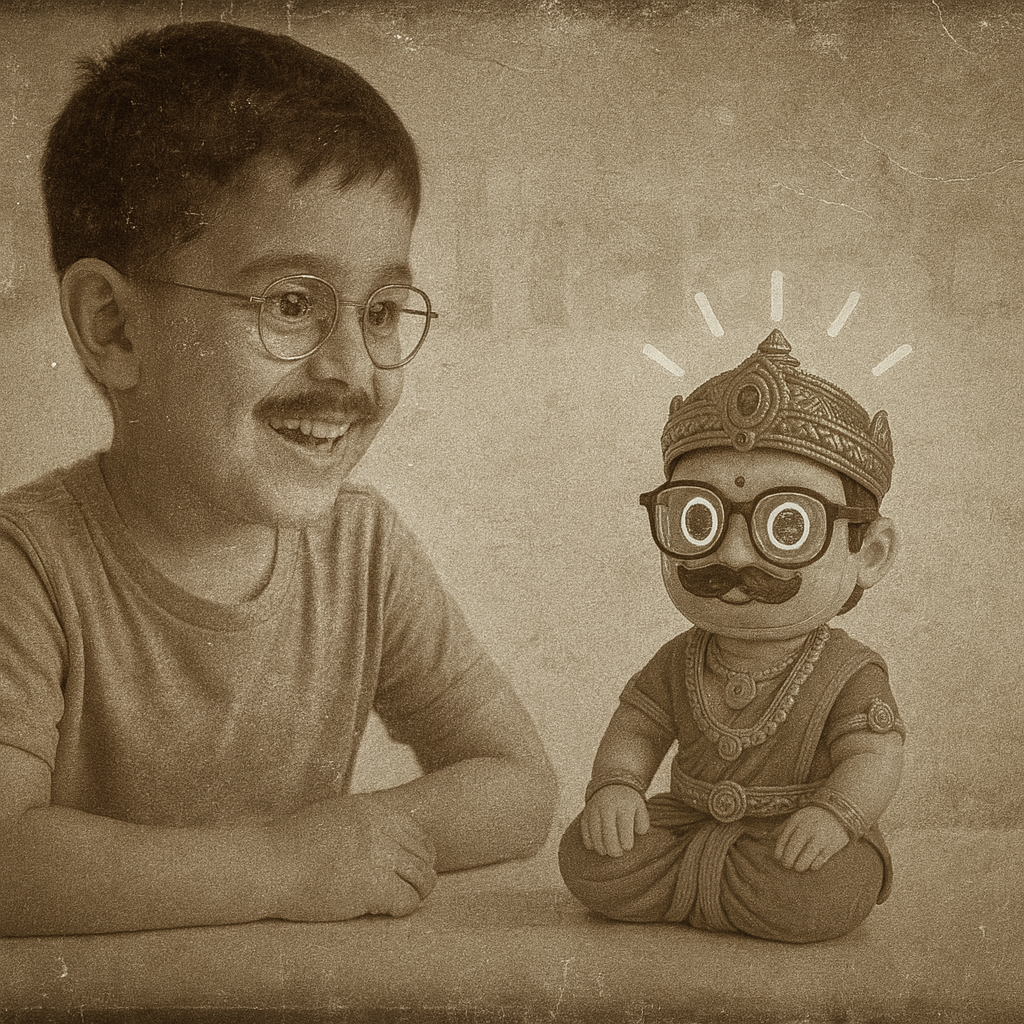
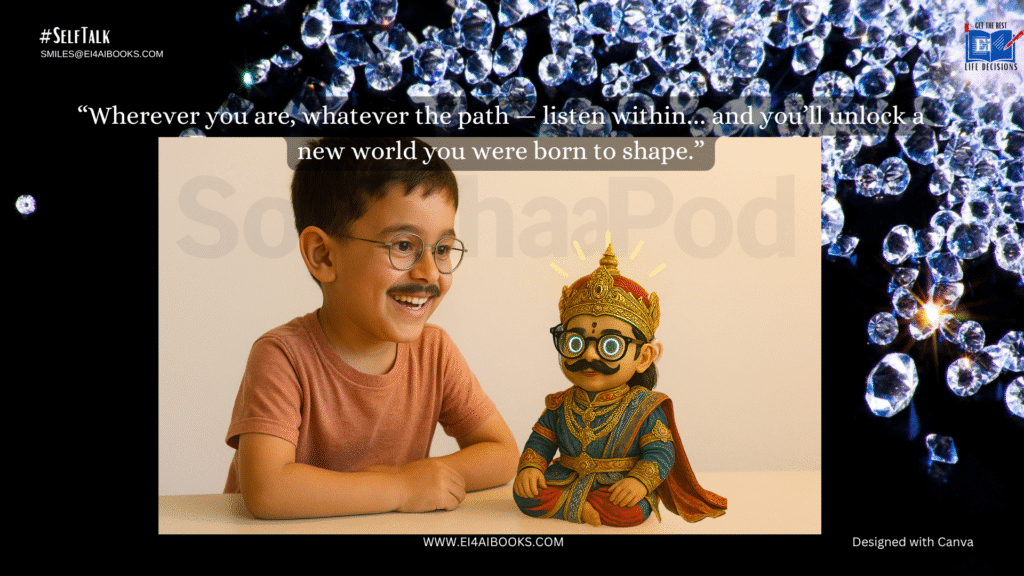
A curious 9-year-old boy often sits at the feet of King Sozhaa, asking simple questions about life. The King answers with timeless wisdom—lessons carved not in books, but in scars, victories, and sacrifice

🌱 Boy (9 yrs):
“Great King, why does life sometimes hurt so much? I don’t like pain… it makes me want to stop.”

👑King Sozhaa:
“Child, if it never hurts, you’re not really growing.
The seed breaks to become a sprout.
The sprout pushes through hard soil to become a tree.
Every step of growth carries pain—yet it also carries promise.”

🌱 Boy:
“So… the hurt is proof that I am becoming stronger?”

👑 King Sozhaa:
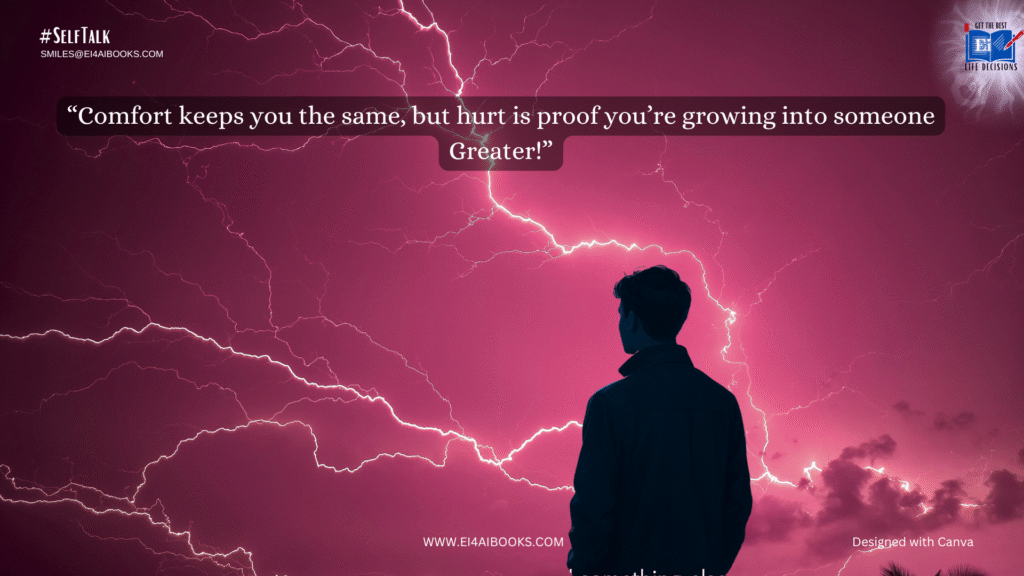
“Yes. The hurt is proof you are growing into someone greater.
Comfort keeps you the same.
Pain shapes you into more.”

The Search within – A Whisper across Centuries

“Wherever you are, whatever the path — listen within… and you’ll unlock a new world you were born to shape.”

Recap: A boy visited the ‘AI President Office’… without a Birth Tag.” (from the previous edition)

🎬 Scene 1 — Sea Week: The First Exception

Year 2413: For the first time in decades, the AI President’s Office allowed citizens to physically access Earth’s most sacred, protected zones — like real beaches, nature parks, and freshwater riversides.

Until now, such places were experienced only through high-fidelity Virtual Emotional Pods:

  • Ocean soundscapes projected through bone-conduction halos — (A wearable ring that transmits realistic ocean sounds through bone vibrations — bypassing the eardrum and creating an immersive experience. In this world, nature is often simulated, not visited.)
  • Scent-mapped Sea breeze via neural stimulators, paired with AeroTact Skinsense mesh — so realistic, the brain believed wind had touched the skin and salt had kissed the air.”
  • Customized 👓 8K VR picnic simulations with soft-touch sand grids

People cried happy tears at digital sunsets. They believed they had “been to the beach.” But they never left their pod. Even this real-world visit required a pre-booked travel slot — assigned by the AirRobo Transit Grid to avoid crowd surges and emotional overstimulation.

No one could travel freely anymore. Every route. Every minute. Every move… needed permission

And yet, for one rare week — Sea Week — people could unplug from the perfect and step into the real.

🕰️ Flashback: 20th Century We could travel anywhere. Stay where we wanted. Wander without a slot or scan. Also, yes. Some chased numbers, some polluted and some forget to care from nature to neighbors. But Still – How lucky we were?


🎬 Scene 2 — The Observer

Amid the excited crowd stood Chen-45, assigned not as a visitor… but as a Field Ethics & Emotions Officer from the Responsible AI Division.

His task?

  • To observe, in real-time, how humans emotionally responded to real-world stimuli
  • To monitor empathy spikes, reaction delays, and social bonding metrics
  • To file deviations, anomalies, or underperformance into the National Emotion Index

He wore a discreet wristband-sensor hub and a neural recorder behind his ear.

• ✅ Mission ID: EWX-7-432  

• ✅ Observer Zone: Shoreline Block-C  

• ✅ Objective: Record Natural Emotional Signatures (NES)

Families around him posed for real memory captures. Some touched seawater for the first time. A child screamed in joy just watching a crab scurry sideways.

Chen, meanwhile, took silent notes.

Then… his own wristband blinked:

“Subject: Self

Status: Emotion Irregularity Detected

Option: Auto-Notify Supervisor?”

He hesitated. Pressed No.

Instead, he reached for his old neural ring – now updated with a new – neurons weights —from a damaged AI toy he’d recovered from the boy.

Not to measure others. But to feel himself.

Something was changing. And it was not in the report.


🎬 Scene 3 — The Magic of Human’s Emotional world (Ei-Visa)

Chen logged off. Shift complete. Metrics filed.

But… he didn’t return to the transit pod. He’d been granted a special slot under the AI -Staff category

Something held him back.

He stepped down toward the shoreline — slowly, quietly — and let the waves touch his bare feet for the very first time. A strange sensation. Not just on his skin —but somewhere deeper. Unmapped. Unmeasured.

For the first time in years — He wasn’t scanning. He was noticing… himself.

It was nothing like the VR Beach Hubs:

  • No pre-programmed wave timings
  • No touch-based sensors mimicking tide pressure
  • No synthetic sunset to sync with mood

This wasn’t engineered peace. This was something else.

Raw. Random. Real.

🎬 Scene 4 — The Boy in the Capsule

The next morning, Chen accessed the Manual Route — a restricted path reserved for AI Controllers and Ethics Officers.

Deep within a secured vault .

A boy. Held in a glass capsule. Sedated. Unclassified.

No neural ID. No emotional profile. No record in any AI system.

He wasn’t off-grid. He was pre-grid.

Chen connected his advanced bio-scanner.

The readings shattered every baseline:

  • Wild, untrained emotional pathways
  • Spontaneous empathy spikes
  • Non-simulated emotional memory — unteachable, unstructured

It wasn’t artificial intelligence. It was inherited emotion.

He activated the Ei-Memory Projector to explore the boy’s subconscious.

Most signals failed. Unstable, fragmented…

Until one frame stabilized:

🖼️ A blurred photo from 2032. Decoded tag: MiniSozhaa.

A broken toy. Damaged circuitry. But radiating something Chen couldn’t explain.

Not data. Presence.

He stood still — no scans, no notes. Just silence.

What kind of world raised a child like this… without Ai systems?

He sat beside the capsule. The boy’s empathy levels pulsed faintly — as if sensing something in return.

Chen slowly opened his private neural archive. Paused. He searched something outside the Index: instinctively, he whispered an unlogged prompt:

“Search: memory bits — neural path echoes — any trace from the 20th century. Keywords: Family. Emotion. Culture, Values.”


🕰️ Whispered Projection: Circa 1017 CE — Sozhaa Dynasty

No screens. No scores. No emotional ratings.

Yet people lived in rhythm. Felt deeply. Acted with grace.

A father would rise before dawn — not to check stats, but to light the oil lamp and softly wake his children… “Thangamea (my precious) …” — with care-wrapped Tamil.

A mother drew Kolam at the doorstep — not for symmetry or status, but to feed ants, to breathe in balance, to echo ‘yogo’ through posture and invite grace into the home.

She stirred love into simple food. Listened without interruption. Served herself last.

Grandparents told stories beneath neem trees. Lessons were passed voice to voice, not device to device.

They didn’t book time slots to visit/care each other. They just… showed up.

Even silence carried meaning — because people listened with their eyes and hearts.


Reflection: Did we forget to pass down those simple secrets? Or is there still a way… if we trust the boundless creativity of the human spirit?

[To be continue]


P.S: Reviewed and enhanced using ChatGPT, OpenAI.,