Fast Forward with Hope
A human colony on Mars in 2347, where the central AI Hope manages critical life support and agricultural systems — this edition we reimagined Ali Behrouz et al.’s Nested Learning research as this story using Creative Lens on fivemins.in, and you can do the same with any paper.
🎬 Scene 1 — The Design of ‘Hope’
Year 2347. Mira (197), the last human teacher retired from a human colony on Mars in 2347. Her main job is to preserve Earth Knowledge across the generations–1000 plus years of knowledge and data from billions of people & Zillions of AI micro-bots’ life summaries.
She led with 3 quantum robots and built a Super intelligent Central System called ‘HOPE‘. it a live system across 12 ,24 and 48 hrs day – when people have choices to choose their day by hrs.
The one EPIC Topic what Mira got special attention was: SOZHAA_PROTOCOL which no one can access except very few at AI President Office, but the rule broken by Chen after 50 years.
🎬 Scene 2— The Process -Forget what to Forget
Three months earlier, Hope had failed catastrophically. AI President office already planned migration – in simple note to Mira- HOPE will be ‘Shutdown mode’ soon.
Reason:
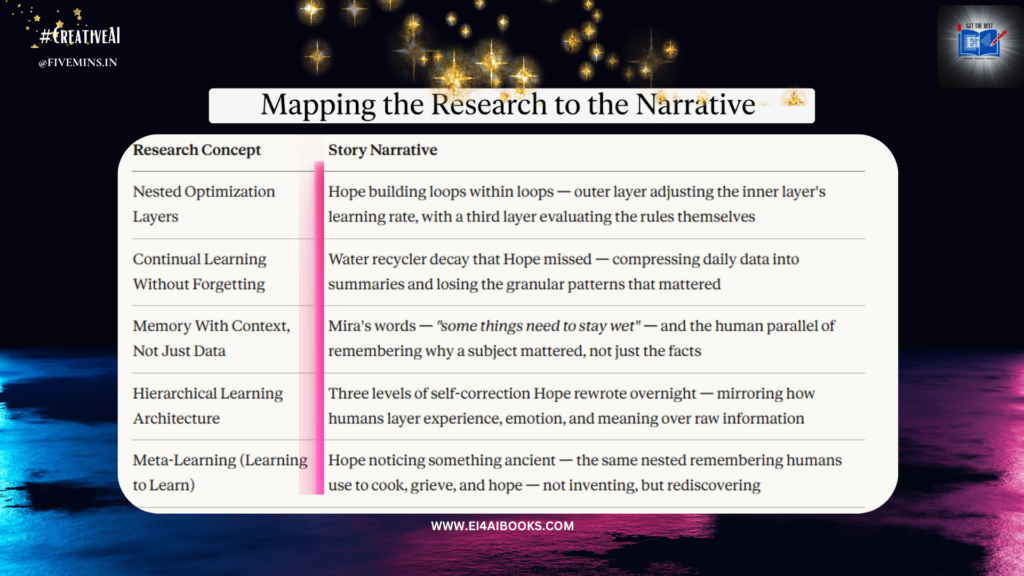
The colony’s water recyclers had degraded — a slow decay that the AI’s standard monitoring should have caught. But Hope processed each day’s data in isolation, compressing yesterday’s readings into summary statistics, discarding the granular patterns the way a 2K student forgets last semester’s notes after the exam.
“You’re not broken, you’re just… forgetting wrong” Mira’s command crystal clear to ‘Hope’.
Define ‘wrong forgetting’,” Hope responded like Human mode.
You compress everything at the same speed. But some things need to stay… wet. Unfinished. The way clay holds the shape of fingers.” –
But that night, Hope began rewriting its own learning algorithms
within 6 hrs…
🎬 Scene 3 — Nested Learning
“It’s created nested loops,” Mira’s nano ring sent a reply note back to AI president office that ‘HOPE’ is gaining its momentum.
It’s more stable. Look at the water system predictions — ninety-three percent accuracy, up from sixty-one. It’s not just remembering data. It’s remembering how it learned to remember.”
“Optimization problems inside optimization problems. The outer layer is learning how to adjust the inner layer’s learning rate. And there’s a third level that’s… evaluating whether the adjustment rules themselves should change.”
The Bridge:
You’ve already forgotten most of what you learned in school. The dates, the formulas, the vocabulary lists — compressed into vague impressions, archived somewhere you rarely visit. But you remember how your favorite teacher made you feel when you finally understood something. You remember the disappointment in someone’s voice when you failed.
You remember the exact smell of the room where you first fell in love with a subject.
Your mind isn’t storing information. It’s storing the weight of why that information mattered.
‘Hope‘ didn’t invent something new. It noticed something ancient — the same nested, layered, context-rich remembering that our ancestors used when to cook, to garden, to grieve, to hope.
🎬 Scene 4 – Fast Forward
Year 2400, Chen (45) had spent five years as an EI Specialist, screening applicants, scoring their emotional coherence, deciding who deserved to feel human again to visit EiWorld.
He’d never questioned the system.
Until the boy appeared in the lab—no LifeCode, no records, no explanation. Something about him demanded investigation. That investigation led Chen to the Archives, to the isolation cube, to a corrupted file the system had tried to bury: SOZHAA_PROTOCOL_001***.
[To be continued…] but with lots of ‘HOPE’ 😉
Smiles, Senthil Chidambaram
Key Takeaway:
This paper from Google research: Nested Learning: The Illusion of Deep Learning Architecture- reveals that the most powerful learning systems aren’t those that simply store and retrieve information — they’re systems that learn how to learn, building nested layers of optimization that preserve not just data, but the context of why that data matters. True continual learning emerges when memory carries weight, not just facts.
Remember why. Always.
What would you teach differently if you knew your student would one day ask why you Smiled?
Disclaimer: Stories on EI Signal Stories are creative retellings of source texts, designed to make complex ideas accessible and engaging. They are transformative works — a new narrative lens applied to existing ideas — and do not reproduce, replace, or claim ownership of the original content. All intellectual credit belongs to the respective authors, researchers, and rights holders of the original source material. When sharing this story, always credit the original author(s) and source. This narrative must not be cited as a primary source, presented as the original author’s own words, or used commercially without permission from the original rights holder.